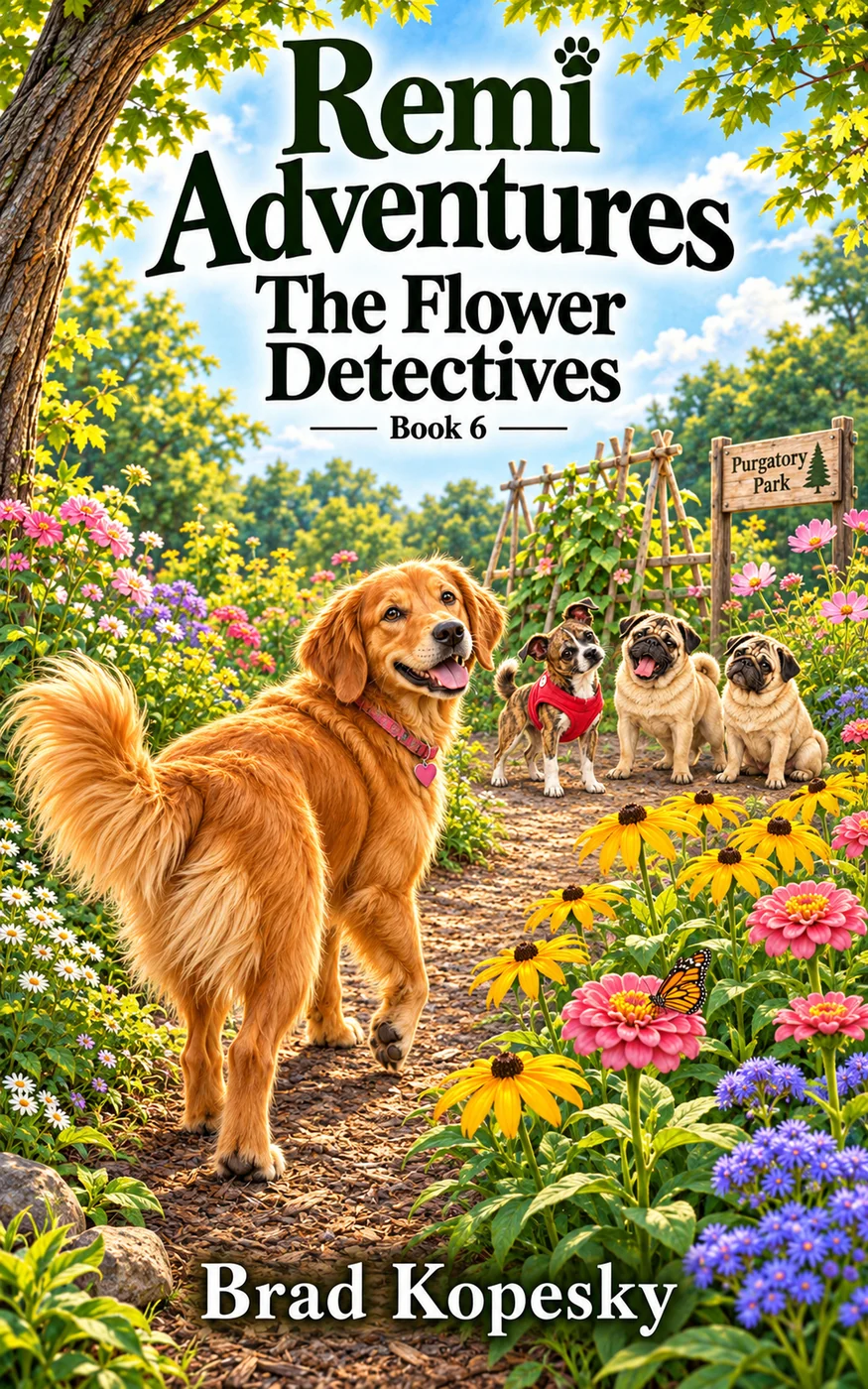
REMI ADVENTURES / BOOK 6
The Flower Detectives
A year of blooms and bugs at Purgatory Park
FROM THE AUTHOR
The real park in this story
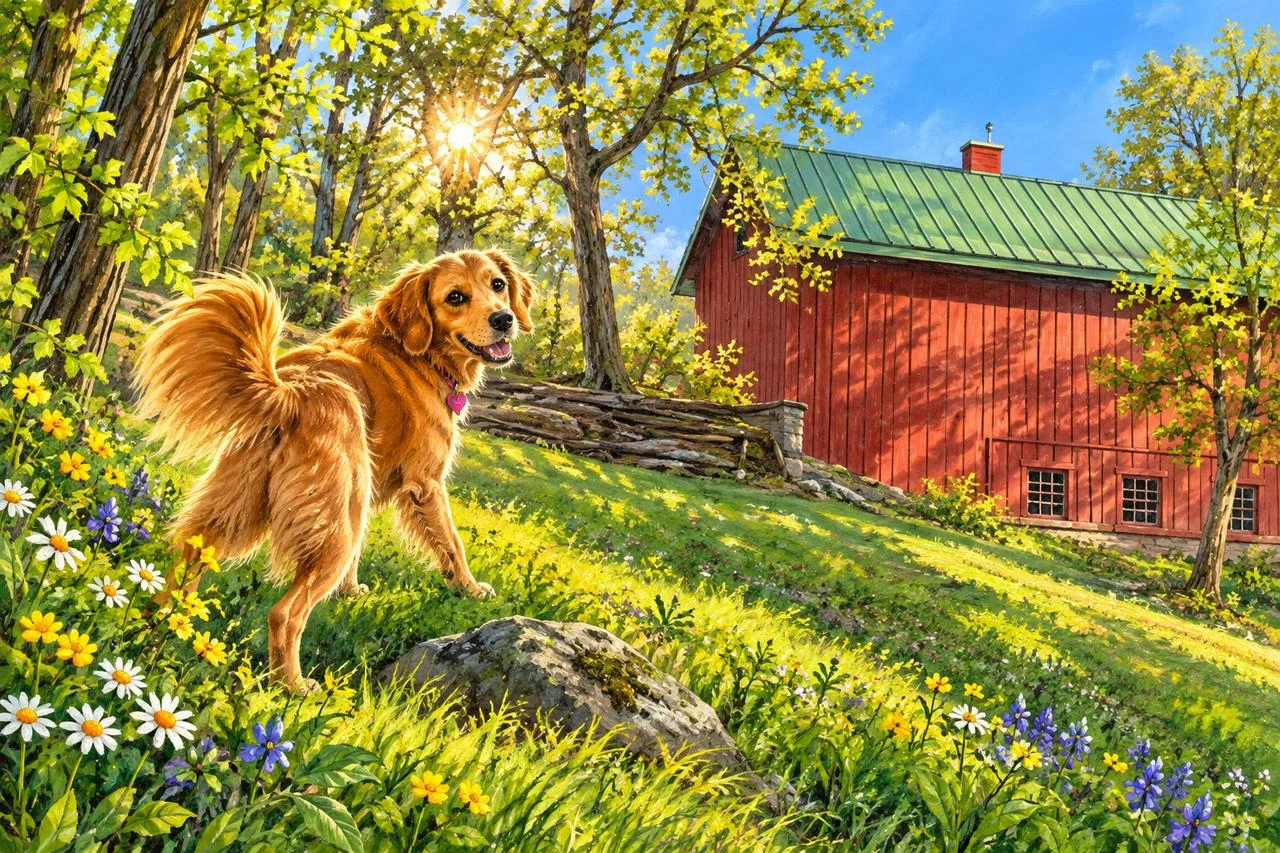
The red barn is on the way to the community gardens at Purgatory Park. Look at the slope beside the building. A dog can walk from the bottom door around to a door on the upper level without climbing any stairs.
The last use I remember for the red barn was as a place to rent cross-country skis for the trails at Purgatory Park. I believe that was in the 1970s. In this story, Remi gets to hear that memory while she and Ava are upstairs.
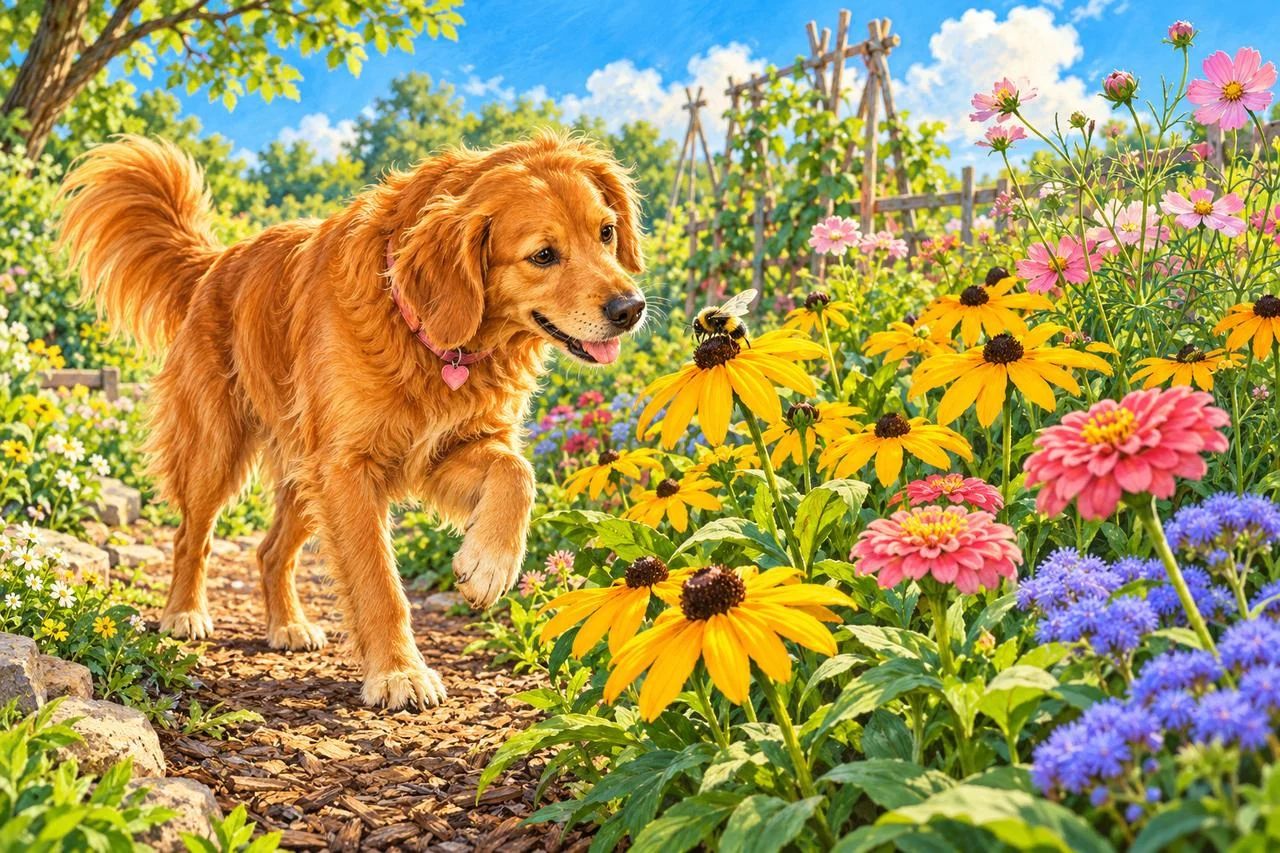
Photographs from our walks guided the drawings of the barn, the flowers and our real dog friends. I imagined the two rooms inside the barn. The gardeners have to clear their plots in the fall, so I chose a summer squash for this story. The little gardener can pick his zucchini while the flowers are still in bloom.
Brad Kopesky
Remi Adventures • Book 6
Minnetonka, Minnesota
BEFORE THE FIRST WALK
Look where the dog looks
I’m Remi. If you take me for a walk, I’ll stop when I hear a tennis ball bounce. I’ll stop for a good stick, too. The day that started this book, a squeaky yellow boot stopped me before I even got to the flowers.
Come along with me. There’s a knock inside a barn, a green pea that blinks, and a boy who wants to know how a yellow flower could possibly make his supper.
CHAPTER 01 / APRIL · THE GARDEN PLOTS
Which Flower Made My Supper?
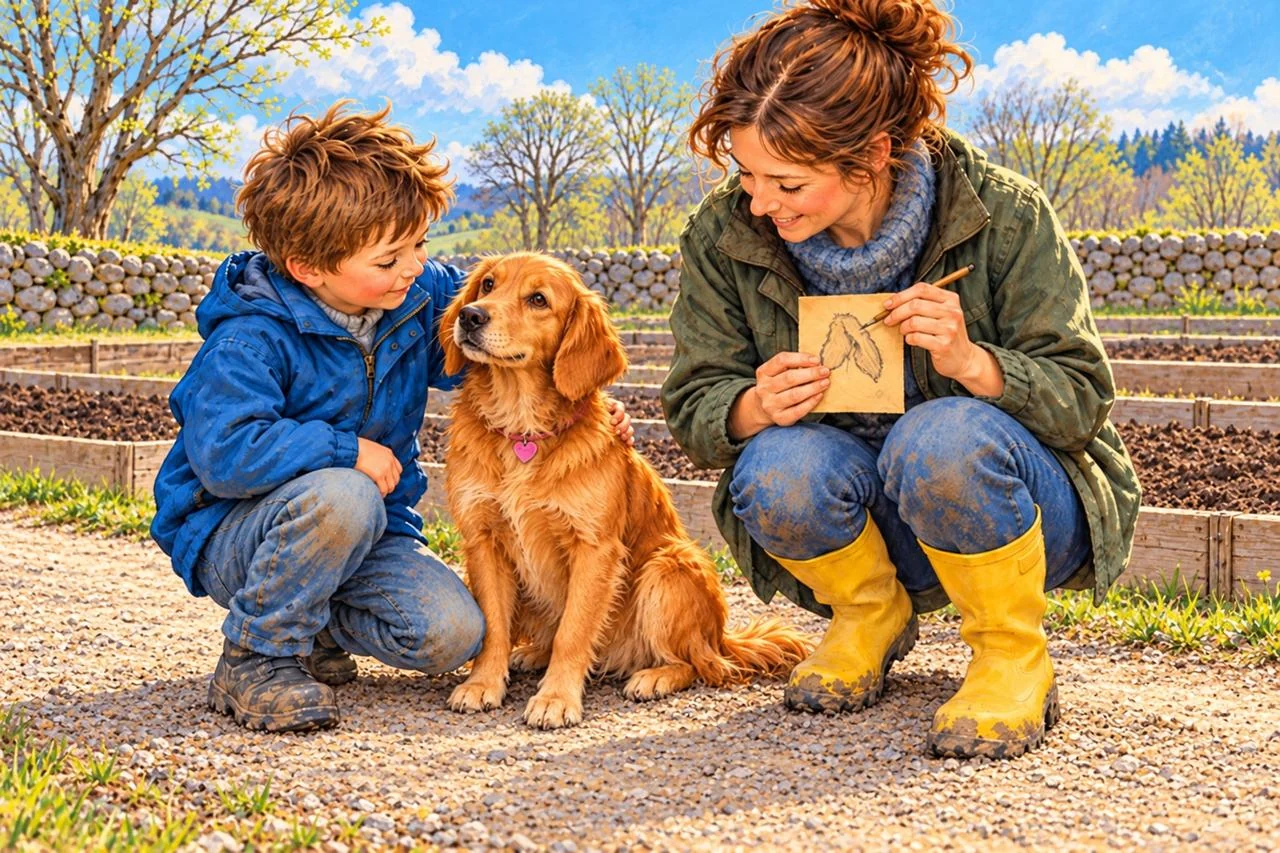
Near the red barn, my human and I followed Purgatory Park’s main trail through the tunnel. My tag jingled going in. The tunnel jingled back.
We came out beside the community gardens. I knew one gardener by her yellow boots. The left one squeaked. She was drawing my ears on the back of a seed packet. Every time that boot squeaked, my left ear turned.
“Remi, could you hold it still?” I could hold it still or I could listen. She was asking a lot of a dog.
It was too cold to plant. Her little boy turned the packet over. On the front was a yellow flower and a long green vegetable. “Which one grows from the seeds?” he asked.
“Both,” his mother said. “Remember the zucchini we sliced for supper? It’s a summer squash. It grows right behind one of those flowers.” He turned the packet over again. There was my face. He looked at me for an explanation.
I knew what grew behind my ear. Usually a burr.
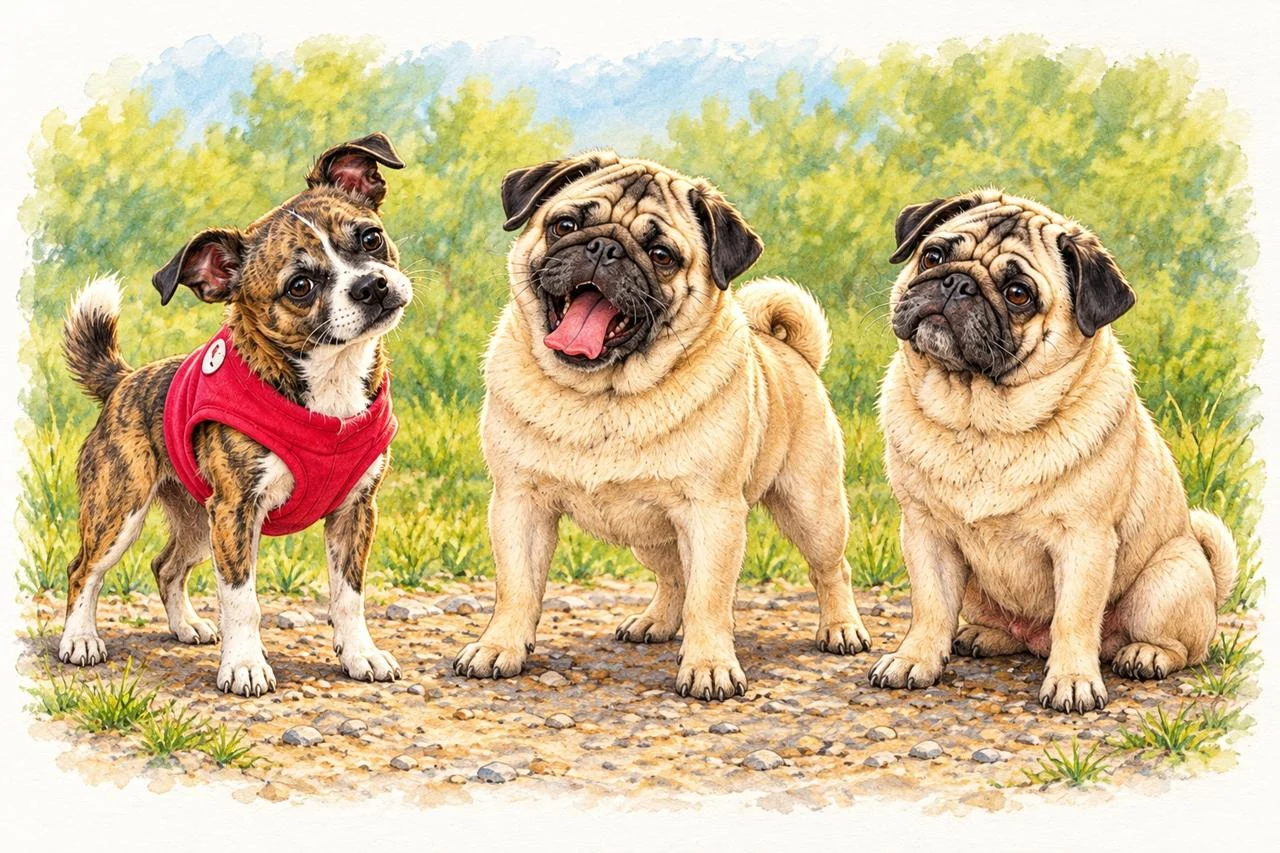
Ava caught up with me while her human stopped to look at the plots. Buster and his brother Bugsy leaned in to see the drawing.
“Where’s the squash?” Ava asked. The boy peered into the packet.
His mother gave it a shake. Something rattled. “Whatever’s in there,” said Bugsy, “it sounds too small for supper.”
The little gardener put his finger on the yellow flower. “I want to see how it happens.” He patted the dog on the back of the packet. “She can help.”
“Let’s find out,” I told Ava. “And when we spot it, let’s get our humans to look.”
He turned the tip of my left ear inside out. His mother drew the fold.
Then he tucked the packet into a blue notebook with room for a whole summer’s worth of clues.
REMI’S LESSON
A good question can fit inside a seed packet.
CHAPTER 02 / EARLY MAY · THE WOODS
Purple Under the Trees

Gizmo said hello with so much of a wag that the rest of the little gray dog came along sideways. Yoda greeted me from the other side. Between those two happy rescue dogs, I got a very thorough hello.
We were just beyond the red barn at Purgatory Park. Through the bare branches, sunlight reached the brown leaves on the forest floor. I was looking up at a squirrel when Yoda said, “Down here, Remi.”
A violet grew beside the path. One flower came no higher than Gizmo’s nose. While I was arranging myself to see it, something fuzzy landed. The violet bowed under its weight.
“One bee,” I said.
“Two flowers,” said Gizmo. The bee had already moved.
Miru stood quietly beside us, tan ears pricked. “Did you see the yellow dust go with it?”
I had missed that part. On the next flower I watched the bee’s furry side brush the middle. Some pollen can travel like that, sticking to a visitor and rubbing off on another flower of the same kind. The bee was having breakfast. The flowers were getting something done, too.
Gizmo’s human had already gone a few steps past us. When Gizmo stayed put, the footsteps came back. Boots creaked and a knee touched the path. “I walked right past a bee heavy enough to bend a flower,” Gizmo’s human said.
On the next bend my human spotted a violet before I did.
I had gone back to keeping an eye on the squirrel.
REMI’S LESSON
For a flower smaller than your nose, borrow a smaller friend’s view.
CHAPTER 03 / LATE MAY · THE LOWER LEVEL
A Knock Under the Red Barn
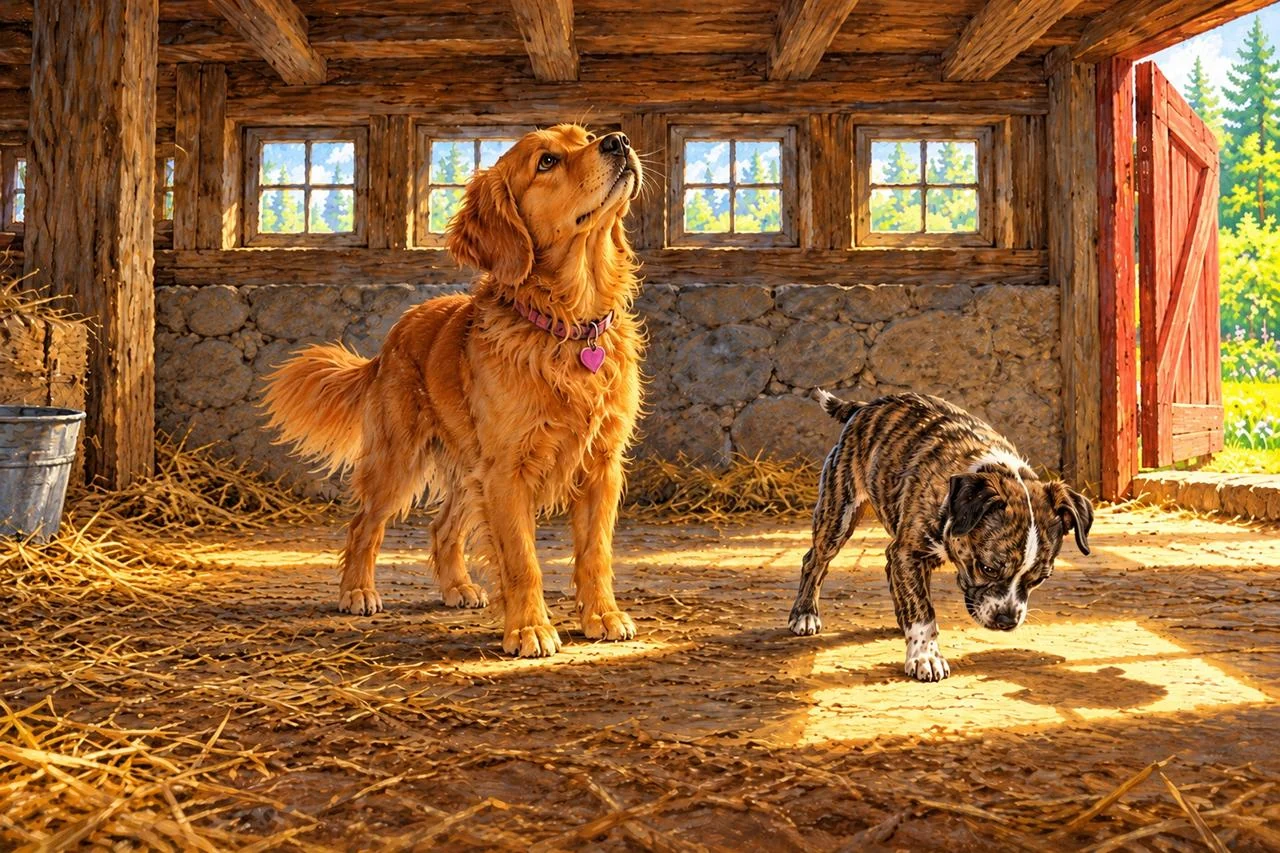
We were on our way to see how the gardeners were getting along when somebody knocked three times. I looked around for a door that wanted answering. Ava looked up. The red barn stood above us on the slope.
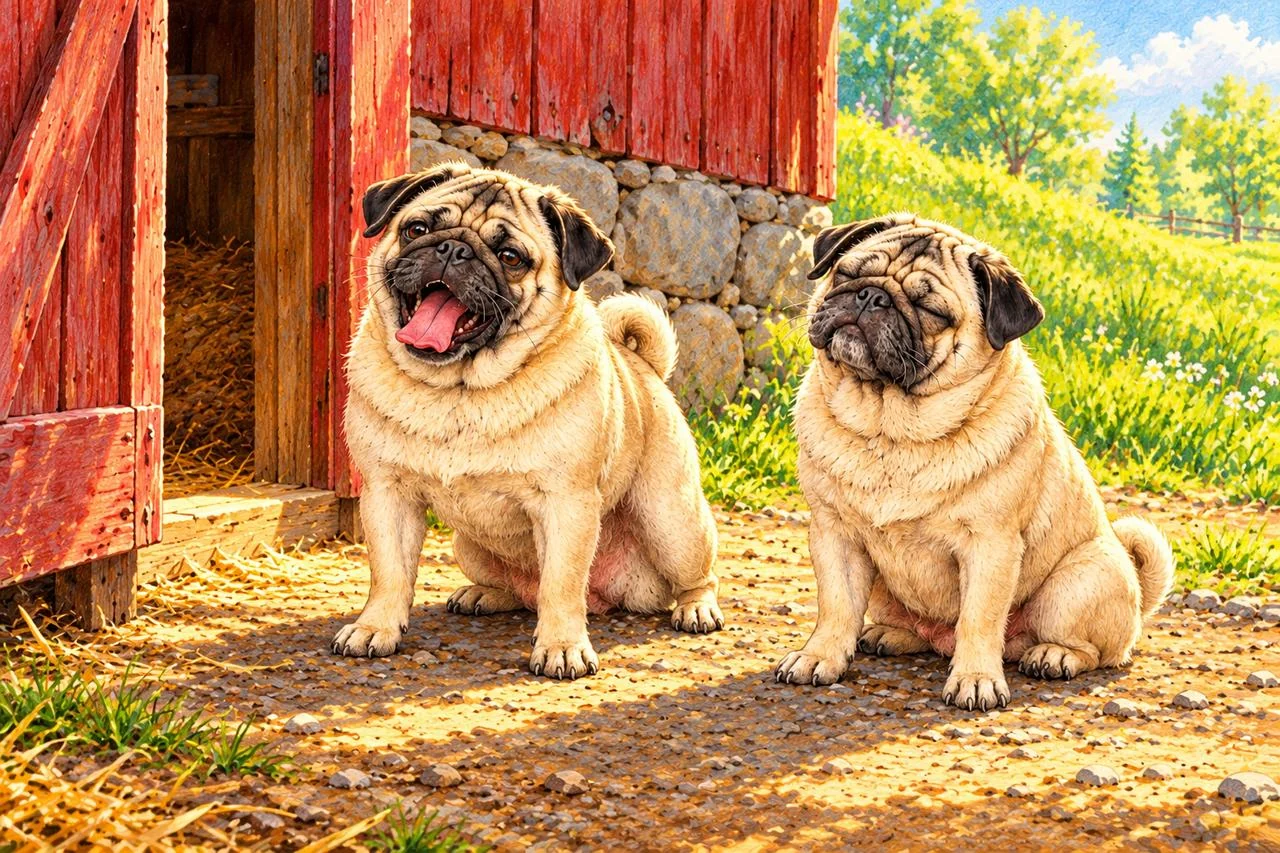
A woman holding open the bottom door had heard it, too. “Come on in with me,” she said to our humans. “You can hear it better from down here.” Ava’s nose and mine crossed the sill together. Behind us, Buster and Bugsy sat down with their human to watch the door. Bugsy took the job so seriously he shut his eyes.
Inside, the air felt cool along my belly. Small squares of light from a row of windows fell on the floor. Ava walked across one square. Something moved in it.
A little brindle dog moved in the next square, too. It was Ava’s shadow. She gave it a sniff, just in case.
Knock. Knock. Roll. We both looked at the windows. This time I saw the sound better with my ears. It had come from somewhere over my head.
“Is somebody walking on the roof?” I asked.
“Closer,” Ava said. She cocked one ear. The rolling sound crossed the ceiling and stopped. “I think somebody just dropped something upstairs.”
I wanted to ask whoever it was to drop it again. I gave one bark. From directly overhead came one answering thump.
Outside, Bugsy opened his eyes. “Good,” he said. “You found a doorbell.”
REMI’S LESSON
Close your eyes for a moment. Can you point toward a sound before you know what made it?
CHAPTER 04 / THE SAME MORNING · THE UPPER LEVEL
The Door That Went Upstairs
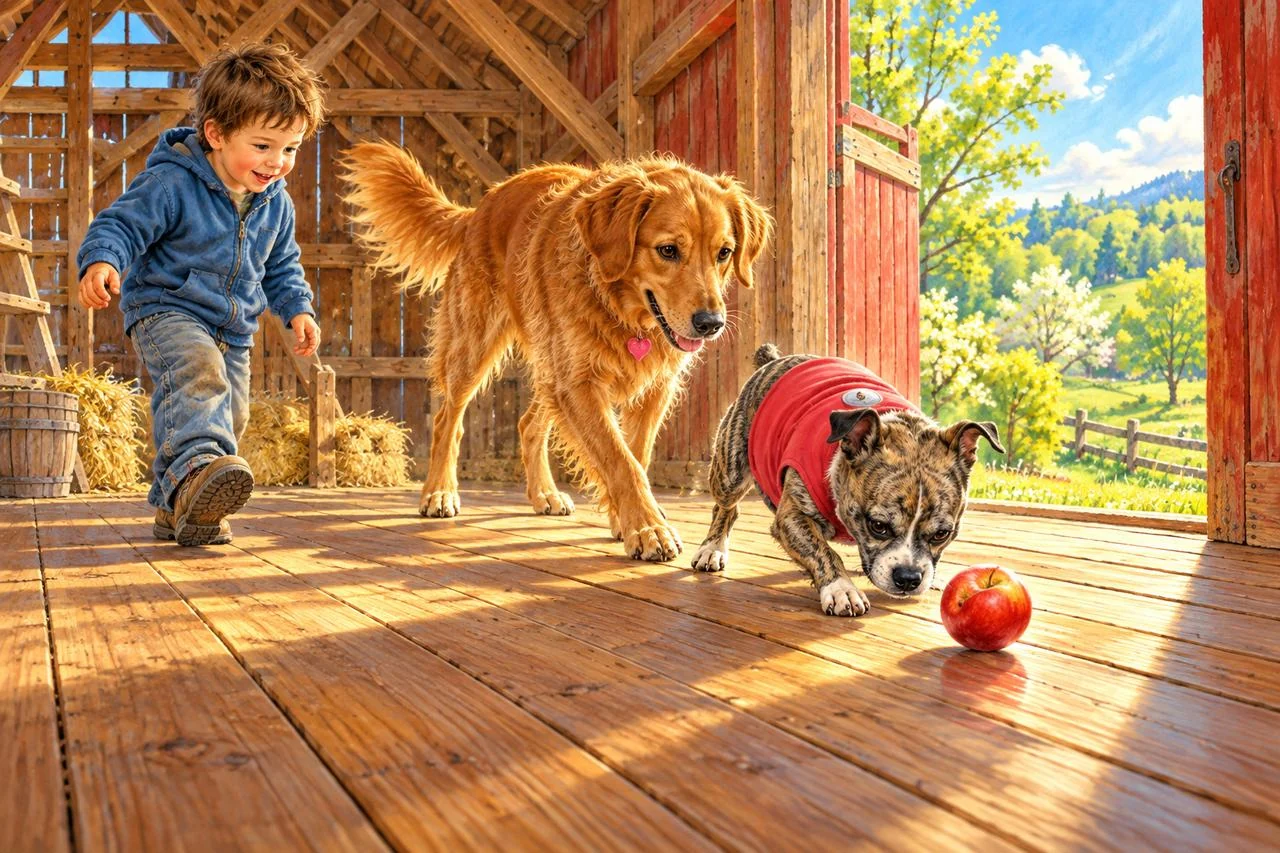
To visit whoever had knocked back, we had to go outside. The woman took us out through the bottom door we’d come in. Then we walked beside the barn, up the slope and around to a different door on the side. I’d gone upstairs without putting a single paw on a stair.
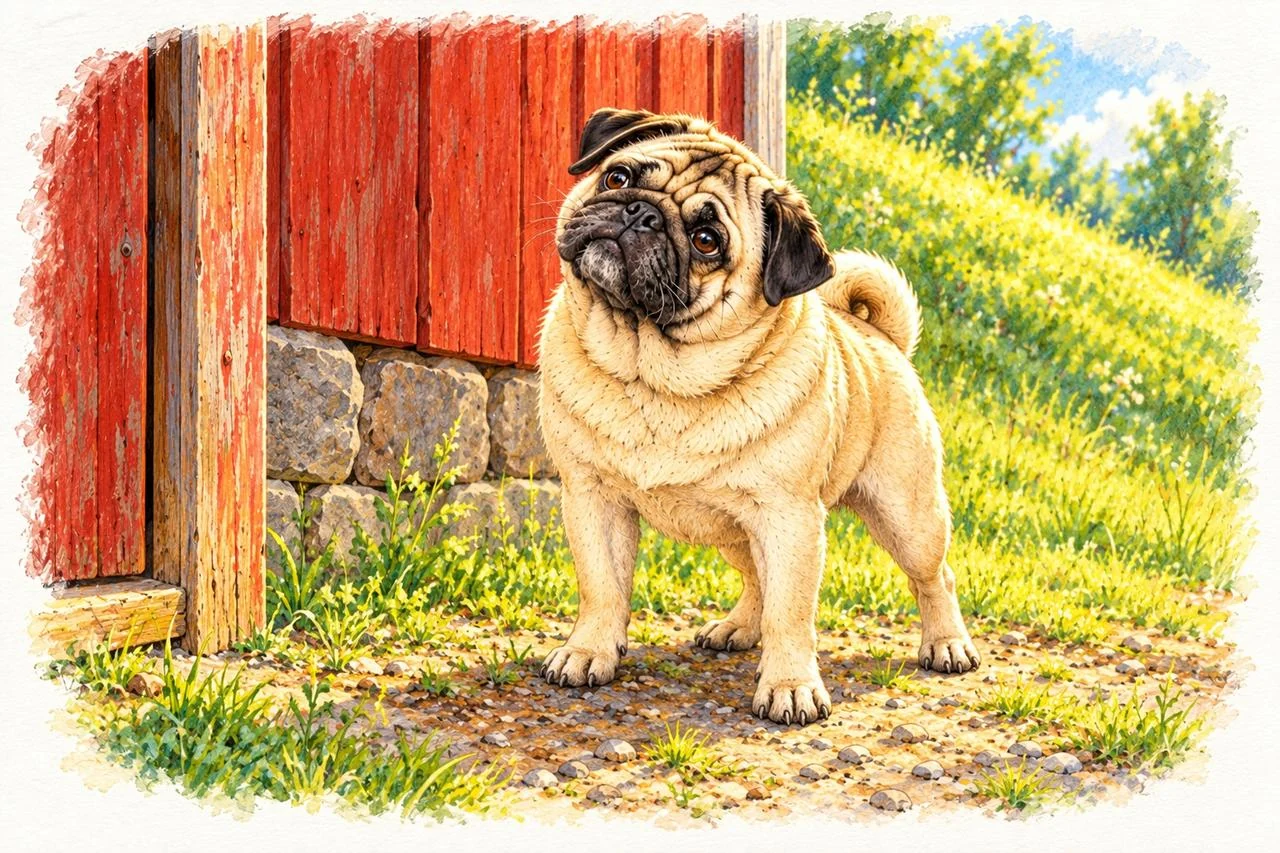
At the upper door, Ava looked back downhill. Buster looked up at her. Each dog had four feet on the ground. They were looking at each other from two different floors.
“How’d you get tall?” Buster called.
“I’ll show you on the way down,” Ava said.
We stepped inside with our humans. At the far end of the room, the gardener in the yellow boots was on her knees. She and the little gardener had come up by the side door. A round apple lay against the wall.
“I dropped my snack,” the boy said. “Then I heard a dog under my feet.” He took two steps toward me. The boards made two good hollow knocks. I recognized that voice, even though it came from a shoe.
Ava sniffed the apple until her nose touched it. It rolled a little way across the boards. There was the other voice we’d heard downstairs.
The boy picked up his apple and polished it on his sleeve. “It rolled away from me,” he said. “Then it rolled to you.”
I looked at Ava. A case solved, and we hadn’t even had to eat the evidence.
REMI’S LESSON
The ceiling over your head can be the floor under somebody else’s feet.
CHAPTER 05 / THE SAME MORNING · A WINTER MEMORY
Four Skis for One Dog
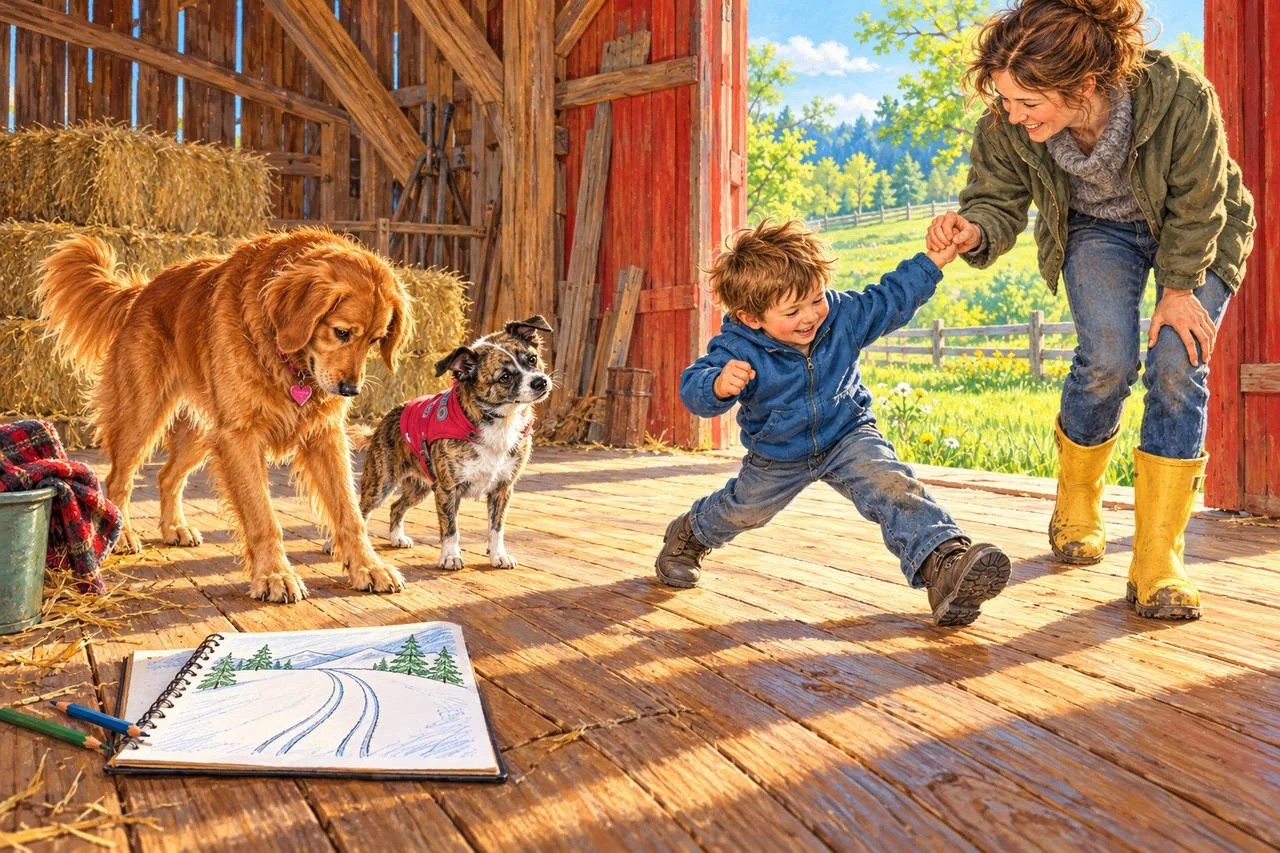
We were still upstairs when the little gardener asked my human, “What did people come here for?”
“Cross-country skis, for one thing. I remember people renting them out of the red barn to ski in Purgatory Park. I think that was in the nineteen seventies.”
The boy looked down at his shoes. “How did the skis fit in here?”
My human held his hands far apart. The boy moved his closer together until he had a pair about the length of his own feet. “Those would be easier.”
I pictured two skinny tracks slipping away from the barn through fresh snow. I tried to fit four paws onto two tracks and promptly had a question of my own.
“I’d need four skis,” I told Ava.
“You already have winter feet,” she said.
The boy showed us how he thought skiing might go. One shoe slid forward while the other stayed put. He tried to push with an imaginary pole, tipped sideways and caught his mother’s hand. For a moment both of them stood quite still. Then the yellow boot squeaked. So did the boy, because he was laughing.
At the door he looked over his shoulder. “When I draw this, should I draw skis in the room?”
“Draw us the room you saw,” my human said. “I can tell you about the winter I remember on a different page.”
The boy drew an apple on the floor. On the facing page, across a whole white hill, he drew two long tracks.
He handed the pencil back to my human to show him where they might go next.
REMI’S LESSON
When somebody shares a memory, you can give it a page of its own.
CHAPTER 06 / THE SAME MORNING · BACK ON THE MAIN TRAIL
Who Barked in the Tunnel
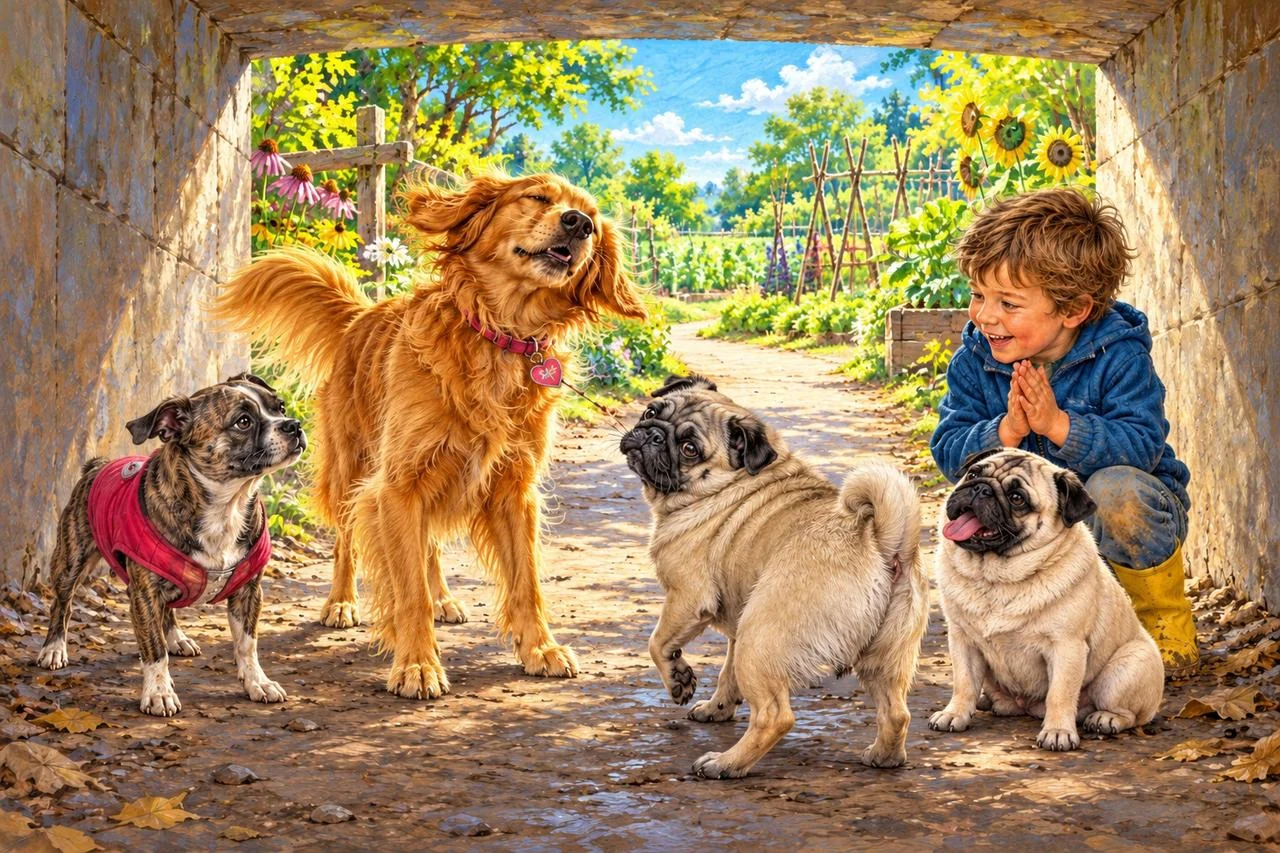
We came out by the upper side door and collected Buster and Bugsy below. Ava walked down the slope until her nose and Buster’s nose were level again. He looked her over. “That’s much better.”
Then we left the red barn behind and went back to the main trail. The tunnel lay ahead. Somewhere beyond it the flower gardener and the vegetable gardeners were already busy. Bugsy had been awake for nearly seven minutes and thought we ought to be there by now.
In the middle of the tunnel my tag jingled. Another tag answered.
Bugsy stopped. “Who’s behind us?”
I shook my head again. So did the other dog, exactly when I did. Buster turned around so fast his leash went under his chin.
Ava waited until we’d untangled him. “Try one bark,” she said.
Woof! A little woof came back. The little gardener clapped his hands once. The tunnel clapped. Bugsy tried being very quiet. The dog we couldn’t see was very quiet, too.
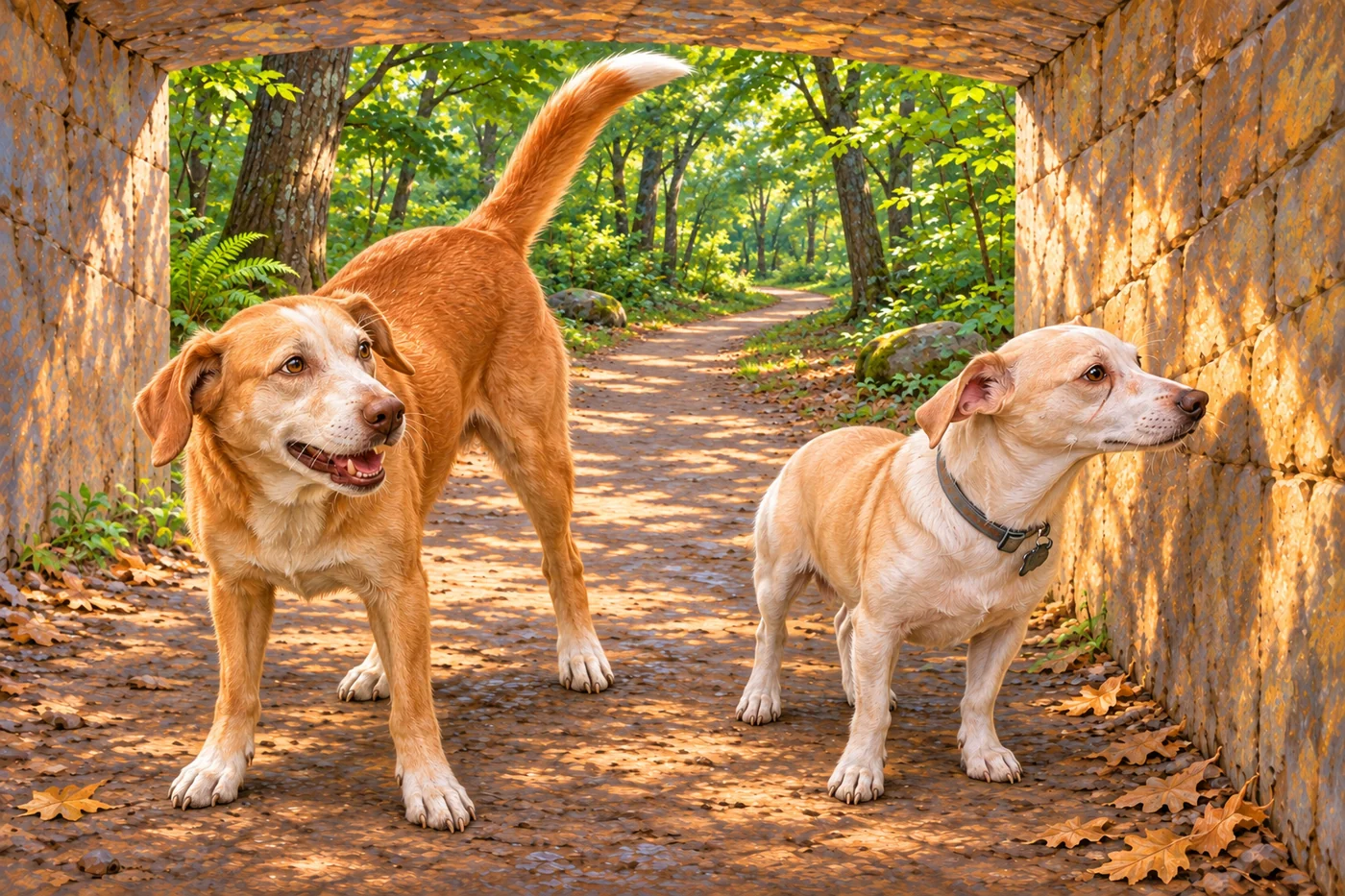
Back at the wooded entrance, Maggie gave a little bark. Odie listened beside her. I answered from the garden end. Our barks echoed along the walls. Odie tipped an ear toward the sound.
At the far end I shook my tag out in the open. This time I got one jingle.
Beyond the tunnel were the community gardens. One gardener was setting out tomato plants. Two plots farther on, another was doing the same. The boy looked back and clapped again. All he heard was somebody clapping dirt from a pair of gardening gloves.
“I know who that one is,” he said. He ran up the path to say hello.
REMI’S LESSON
At the tunnel, listen to one sound. Try the same sound again out in the open.
CHAPTER 07 / EARLY JUNE · THE VEGETABLE PLOTS
The Row with No Sign
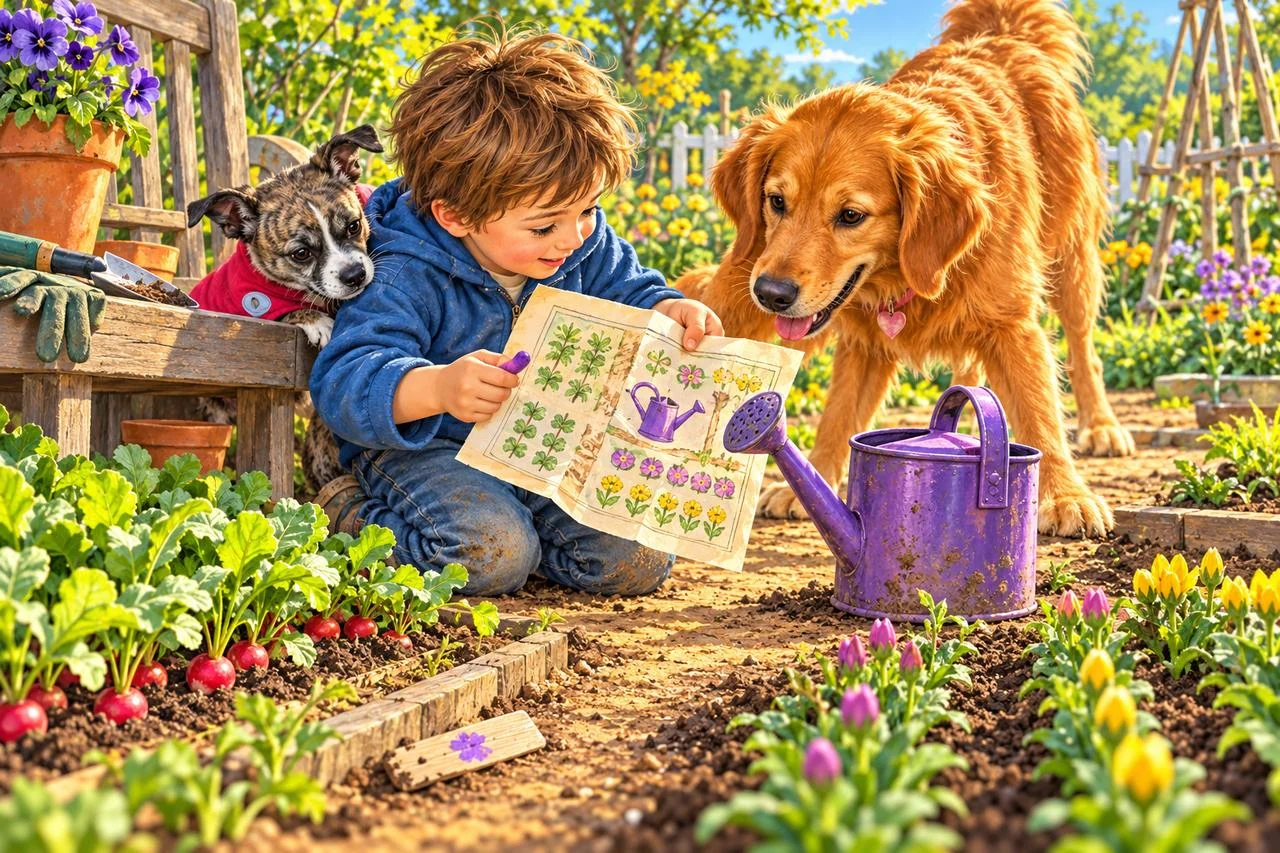
One wooden marker lay flat on the garden path. The rain had washed its letters down into a single purple smudge. The little gardener picked it up. On one side of him were two rows of green leaves. On the other were three rows of different green leaves. He stuck the marker in the first row.
“What grows there?” I asked Ava.
“I was hoping you could read purple,” she said.
His mother knelt beside the first row. “Could be radishes.” The boy started pushing the sign into the soil.
“Could be,” she said again. He stopped pushing.
At the end of the path sat the flower gardener with a pencil behind her ear. “I drew my rows when I planted them,” she said. She unfolded a scrap of paper. There was a wavy line for the path, a square for her watering can and three short rows beside it.
We turned the paper one way. Now the can in the drawing stood on the wrong side. We turned it around. The real can and the little square all but shook hands.
Those three rows were flowers. The two across the path were radishes. But where had the marker come from?
The boy held it over the empty plot of ground between them. “We know what’s growing,” he said. “We still don’t know where this was.”
He set the marker on the bench and made two fresh ones. By the time we left, his thumb was purple.
I could have identified that thumb anywhere.
REMI’S LESSON
Turn a drawing until something on the paper lines up with something you can see.
CHAPTER 08 / JUNE · THE WOODLAND EDGE
A Stick with Flowers
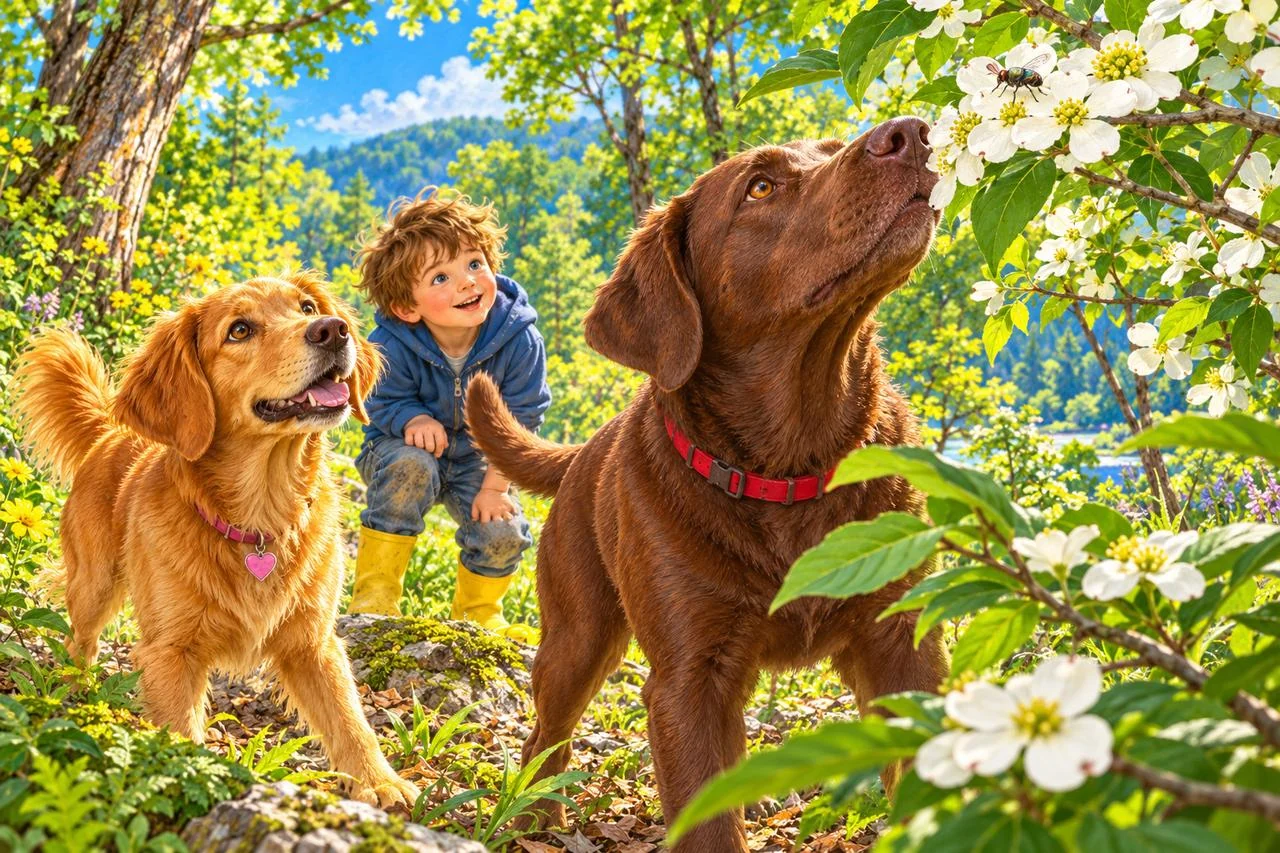
When the soil warmed at the end of May, the boy and his mother planted their zucchini seeds. He watered one spot so thoroughly that his left boot stuck in it. By June the biggest leaves were as broad as my ears and considerably more obedient.
At the edge of the woods that month, Choco caught me eyeing a stick. It was still attached to a bush.
“Look up the stick,” Choco said.
The branch ended in a cluster of white stars. I knew about sticks and I knew about flowers. Finding both on the same piece of wood felt like discovering a ball that also gave neck scratches.

Winston, who answers to Winnie, had joined the morning walk. He put his nose into the wind. “That whole white puff is one flower?”
Tasha’s pale curls lifted in the breeze. “Let’s count the middles.”
We counted three middles before the breeze tipped the branch and showed us a dozen more. Each little flower had four white petals. Choco’s human followed that amber-eyed gaze up the branch. “Gray dogwood! I’ve walked under this bush for years. Look at all those flowers.”
“They named a stick after us,” Winnie said with satisfaction.
A fly walked from one flower to the next without using its wings. Choco’s human took a picture close enough to see its feet. Our visitor had found an entire lunch counter at the end of one stick.
I left the branch attached. I wanted to come back and see who else ate there.
REMI’S LESSON
A shrub can hold a whole cluster of flowers at the end of one branch.
CHAPTER 09 / EARLY SUMMER · THE FLOWER PLOTS
The Bee That Fooled Me
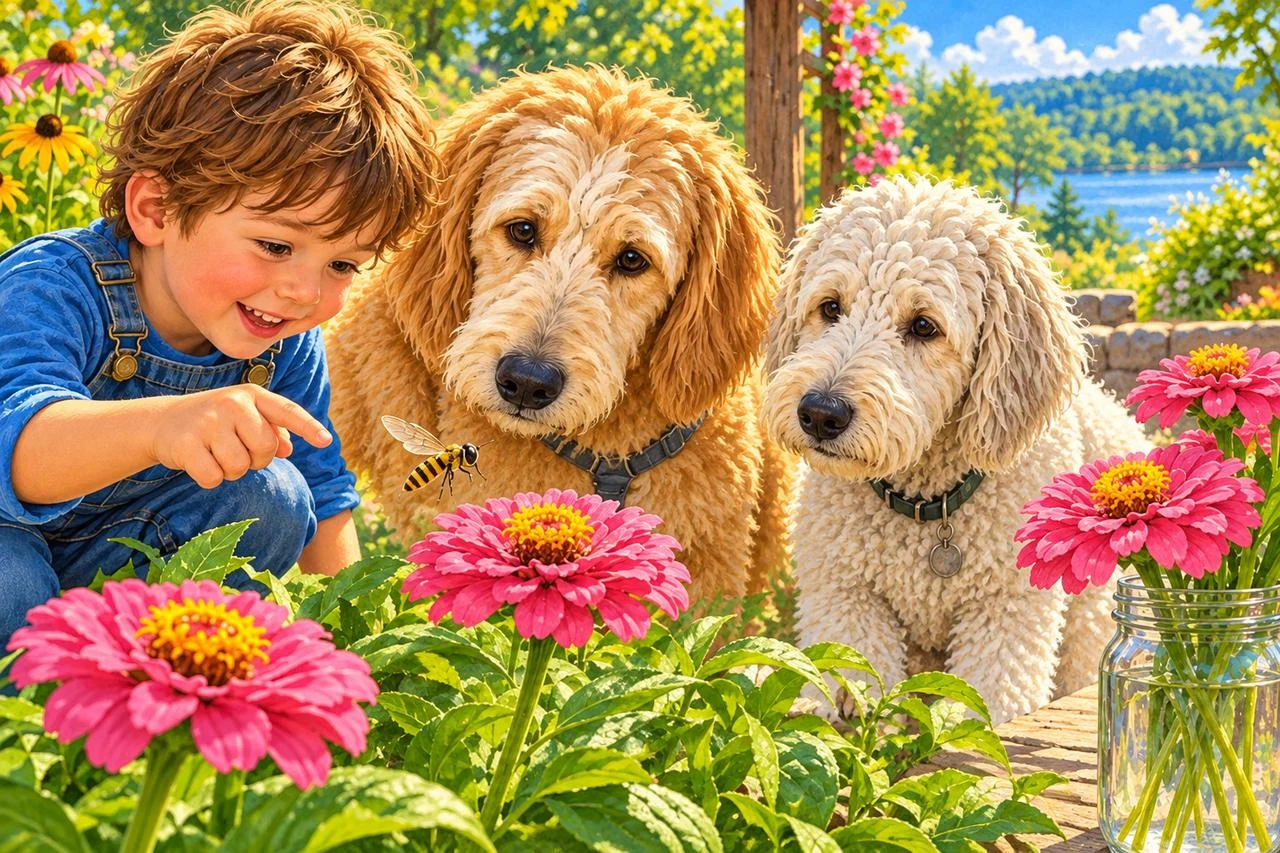
We passed lettuce, beans winding up strings, and more tomato plants than I had toes to count. In one plot the sweet corn was up to the boy’s knees. Across the path, the flower gardener let him choose three zinnias for her jar. He chose pink. Then pink again. Then, after a long think, pink.
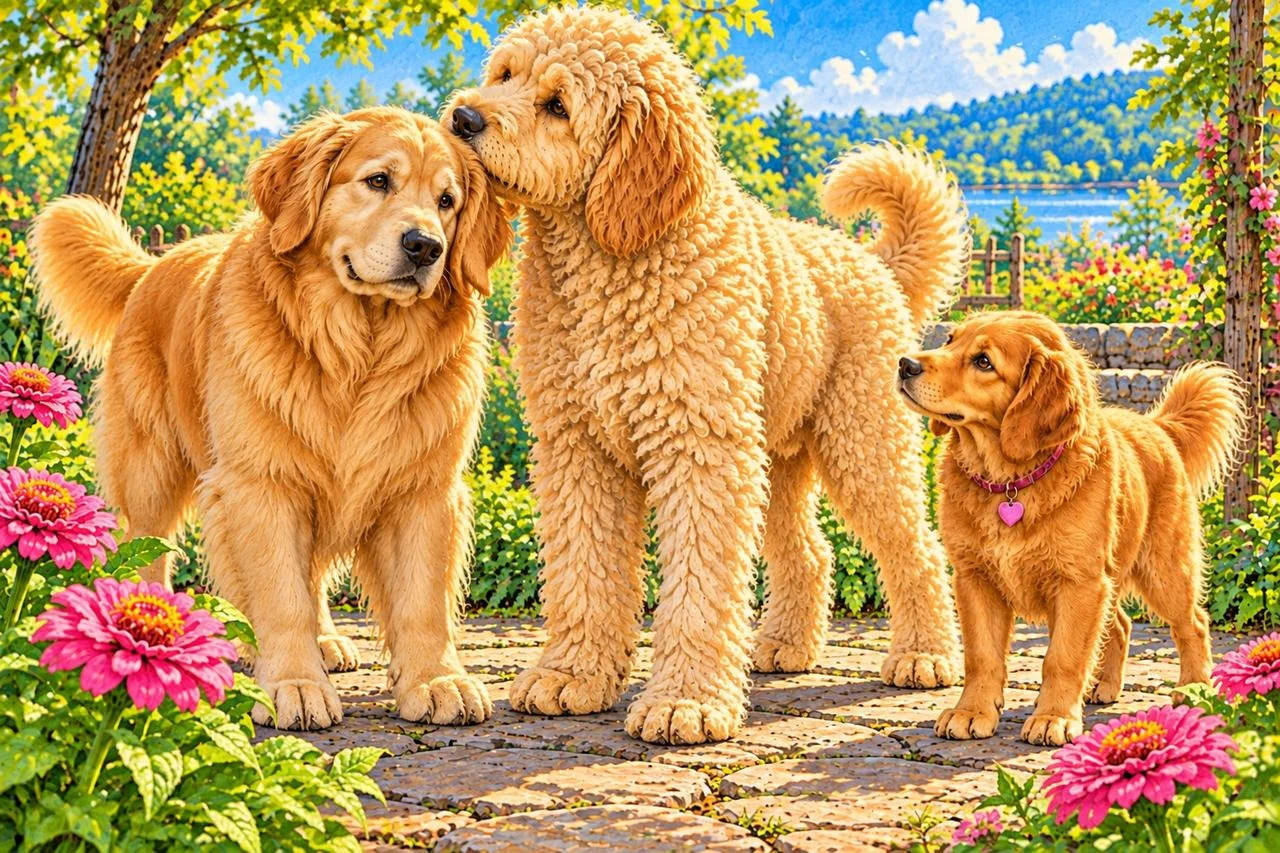
Gus, our big cream Goldendoodle, stood beside the jar. Finnegan Gilbert came to look over his shoulder. Finnegan was still a puppy and already bigger than Teddy. Teddy leaned over to greet him and got a wet puppy kiss right in the ear.
A yellow-and-black speck hung in the air beside a zinnia. It shot backward and stopped in exactly the same place.
“Bee,” I announced.
“How did you decide?” Gus asked.
Stripes, of course. Gus kept his muzzle pointed at the insect until his human took a picture. Finnegan watched the photo grow big on the screen. “One wing on each side,” he said. A hoverfly! Flies have one pair of wings. Bees have two pairs that can be hard to see when they’re moving.
“If I’d called it a fly,” I asked, “would you have believed me?”
“I believed you the first time,” Finnegan said. “That’s how we both got it wrong.”
“I nearly wrote ‘bee’ under that picture,” Gus’s human told the flower gardener. They watched the hoverfly dip its face into a zinnia. A little dust clung to it when it lifted away.
The little gardener took his three pink flowers home in the jar. I took home a question.
What else had I been calling a bee?
REMI’S LESSON
A photograph can show a pair of wings that whizzed right past your eyes.
CHAPTER 10 / EARLY SUMMER · THE GARDEN PATH
The Carrot That Took a Turn
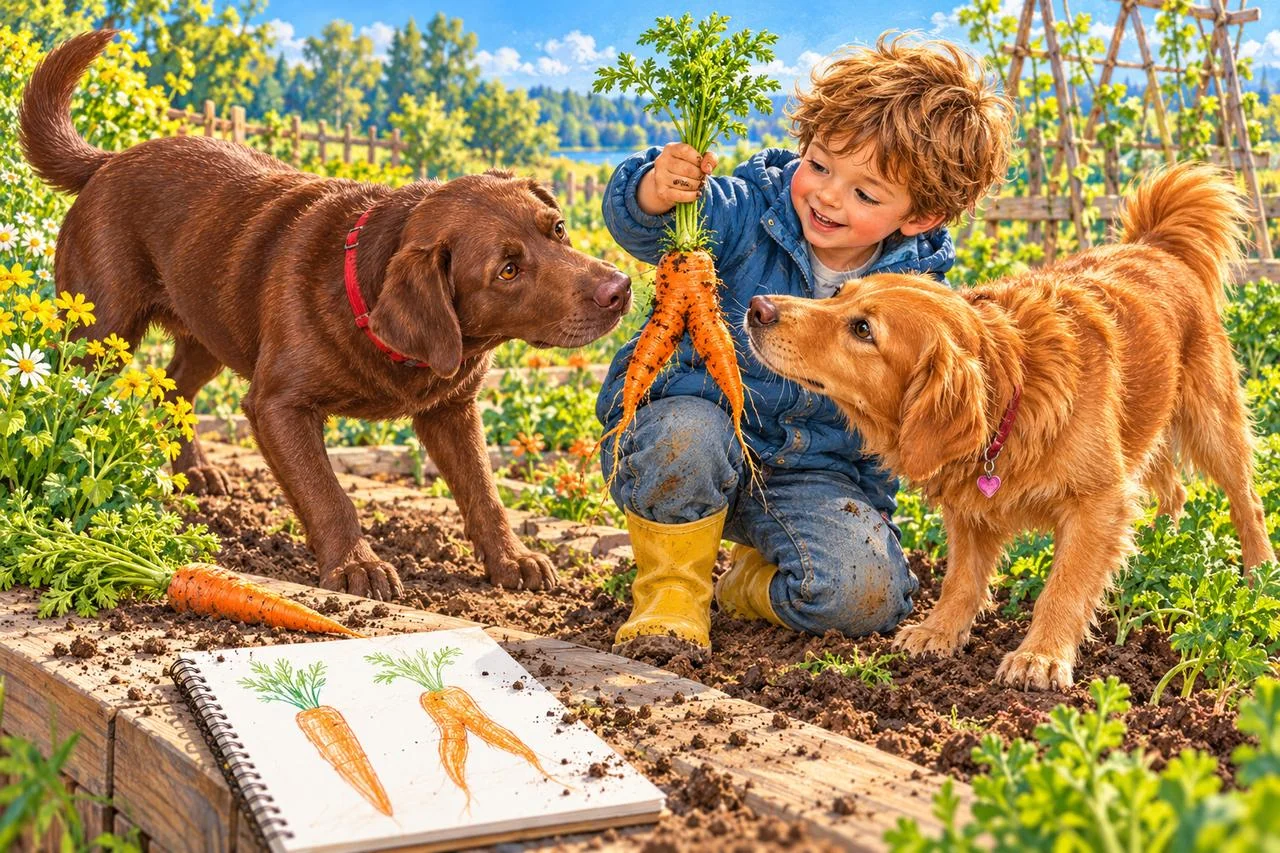
I was counting round green cabbage heads when the boy held up two orange legs with green hair. I lost count.
“Somebody grew a dog!” I said.
Choco looked at the legs. “Where would the tail go?”
The boy pulled a straight carrot from the same row. The forked one smelled just like it. His mother set them side by side for him to draw.
The boy drew the straight one first. He started the second one, frowned and rubbed out one leg. Then he drew a nice straight carrot where the forked one should have been.
Choco’s nose went straight to the real carrot with two legs. So did mine.
“You both want that one?” The boy turned the funny carrot around. On his page he had two carrots that looked alike. On the path he definitely didn’t.
He dipped his pencil in a little mud and pressed a dot where the root divided. From that dot he drew one line left and one line right. Then he carried his carrot up the whole path with his fingers doing its walking.
Later, his mother washed it. She cut two round coins from one end and one big coin from the other. The boy ate all three.
“Which one was the funny part?” his mother asked.
He chewed thoughtfully. “Can I have the rest? I forgot to pay attention.”
REMI’S LESSON
Try drawing the thing in front of you, even if you know what a carrot usually looks like.
CHAPTER 11 / JULY · THE VEGETABLE PLOTS
The Case of the Empty Stems
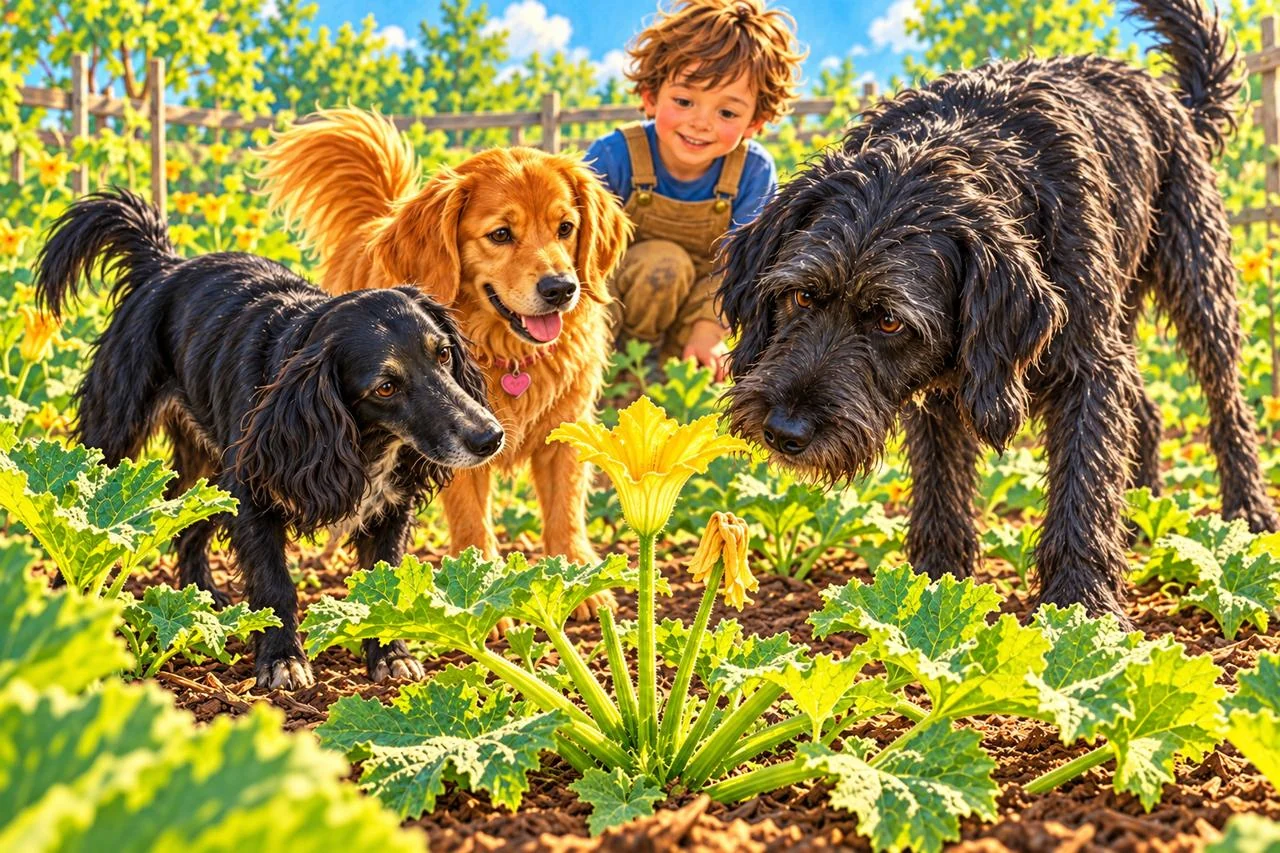
A trumpet the color of melted butter stood above the squash leaves. The boy’s mother drew it in his blue notebook.
By afternoon the trumpet had folded shut. A few days later it dropped, leaving a long skinny stem.
Then the next flower did it. And the next.
The little gardener frowned. “Did we lose it?”
“Maybe somebody’s been taking our supper,” I whispered.
Bert’s long, wavy ears brushed the path. “What size was the squash when you last saw it?”
I thought hard. I’d seen a yellow flower yesterday. Before that I’d seen a yellow bud.
“Did you ever see a squash?” Asher asked from under those wonderfully shaggy eyebrows.
That rather spoiled my case against the supper thief.
Bert dipped his nose beside a fresh blossom. His human crouched, and the boy’s mother joined them. “I’ve been drawing the flowers and leaving off the stems!”
“These skinny stems hold the pollen-making flowers,” Asher said. “The female flowers often open later. They have a little swelling underneath.”
The little gardener watched her draw the stem. “What should we look for tomorrow?”
“Same yellow top,” Bert said. “Different bottom,” said Asher.
I decided the supper thief could have the morning off.
REMI’S LESSON
Two blossoms can look alike from above. Try looking underneath.
CHAPTER 12 / A JULY MORNING · THE SQUASH PATCH
The View from Ruby Height
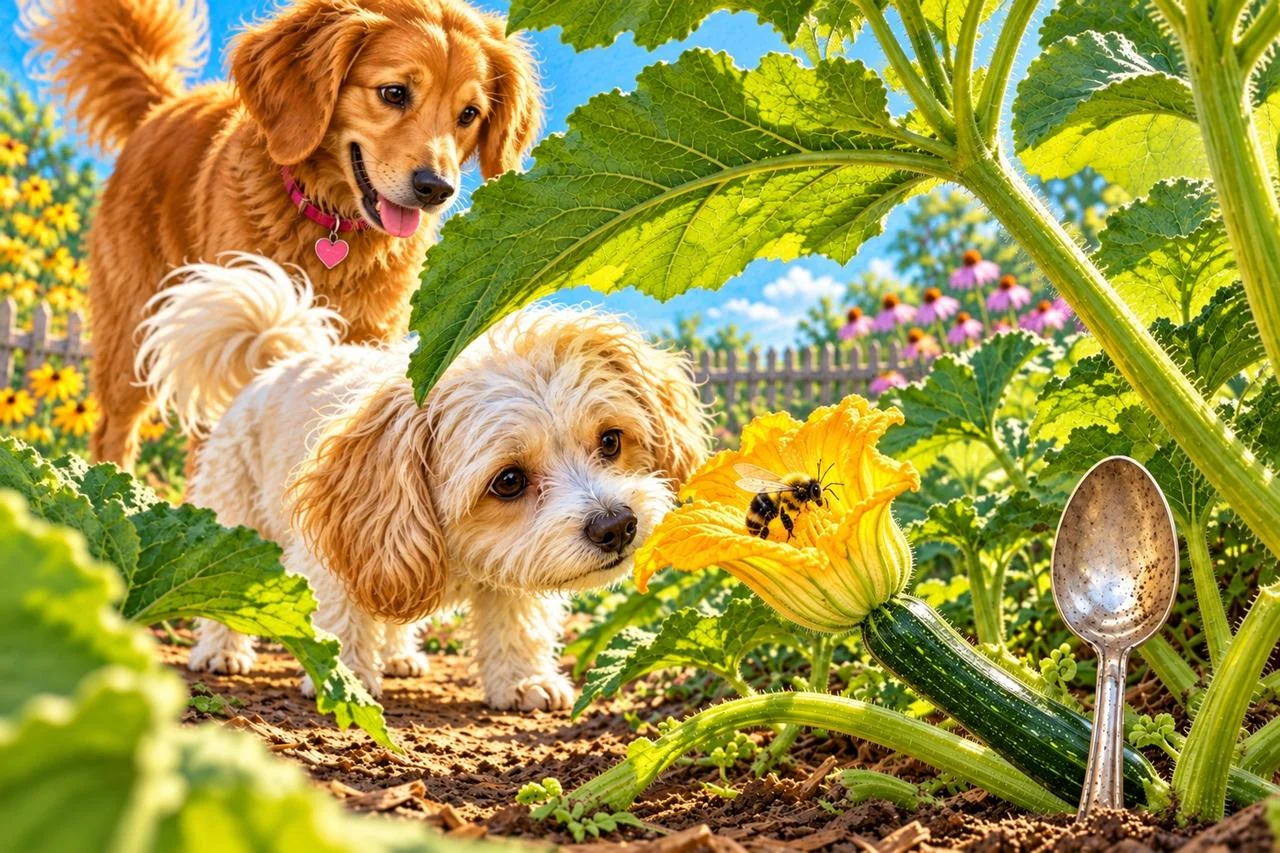
Several mornings later, Ruby found our flower. This was the small white-and-cream Ruby with the plume of a tail. I could see over the leaves. She could see under them.
“This one has a little green finger sticking out behind it,” she said.
Her human knelt beside the path. “Come around to Ruby’s side!” A tiny green zucchini held a yellow flower at its tip. The little gardener stuck an old spoon in the soil beside it.
A bumble bee landed on a long-stemmed blossom and came out dusted yellow. In the flower by the spoon, its fuzzy back brushed the sticky center. The pollen had reached just the right place.
“Pollination,” I told Ruby. The boy’s mother drew a bee and an arrow between the flowers. The boy rubbed a yellow pencil over the bee’s back. “So that’s how it got a ride.”
“Will the green part get longer?” Ruby asked.
“If enough pollen gets there, seeds can start growing inside,” I said. “That little green part can grow around them.”
Two more bees visited. The little gardener drew the tiny zucchini exactly as he saw it, with the flower nearly hiding it.
By noon the petals had folded. The little gardener drew a star on the spoon so he could find our flower again.
“What should we put in the notebook tomorrow?” his mother asked.
He held his fingers a little way apart. “How long it is.”
REMI’S LESSON
A bee can carry pollen from one zucchini blossom to another. Look behind the petals to find the flower with a tiny squash.
CHAPTER 13 / LATER IN JULY · A MORNING WALK
Enzo Takes a Measurement
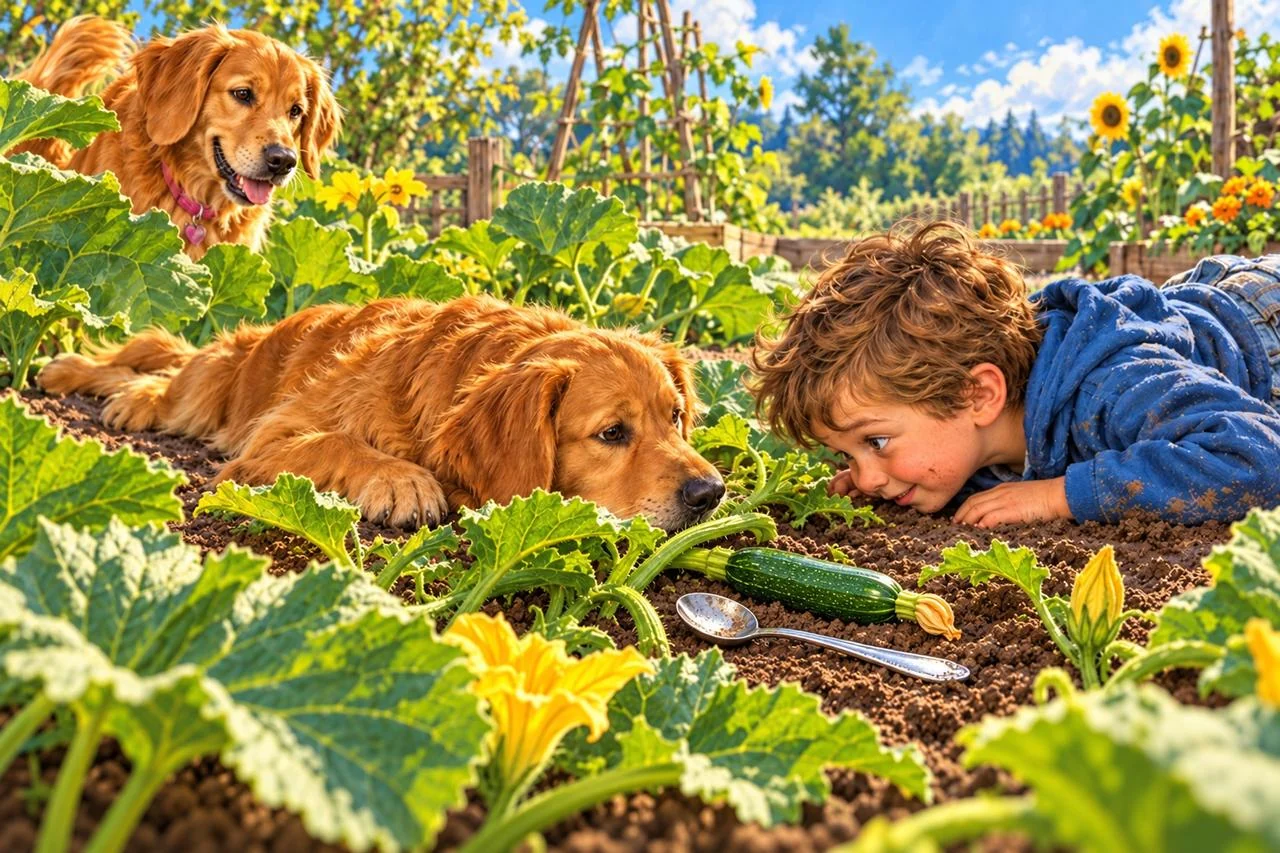
Duke came out of the woods that morning with his younger brother, Enzo Ferrari. Enzo’s golden fur was as soft as silk. The little gardener discovered this with both hands.
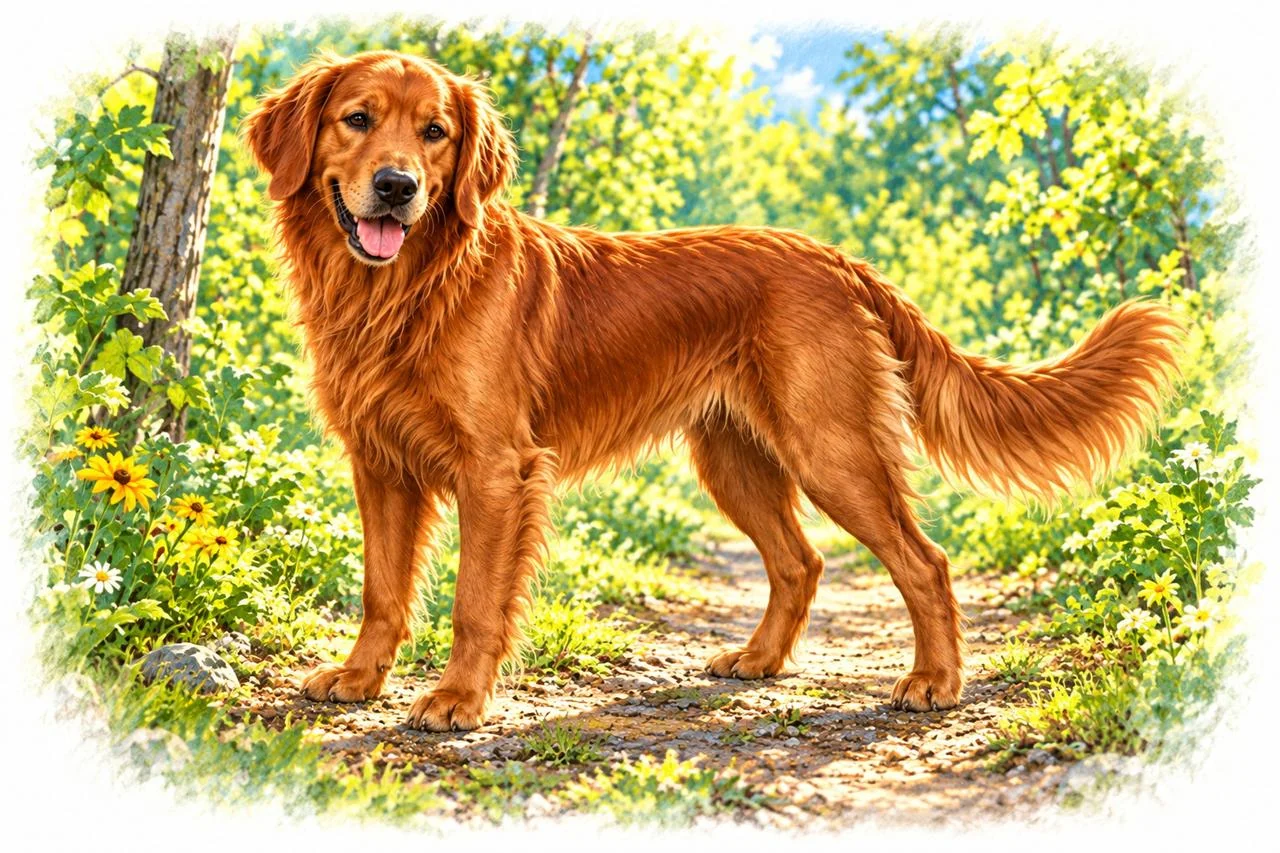
Enzo settled on the path with his back legs stretched out behind him. His chin was level with the soil in the squash patch.
The boy pulled up our spoon and laid it beside the zucchini. “From here,” Enzo said, “it’s nearly as long as the spoon.”
From where I stood, there was no green tip at all. A squash leaf was in the way. I lay down beside Enzo and stuck my legs out behind me, too. My back half didn’t seem to have received the same instructions as his.
“You only need to lower your chin,” Duke suggested.
The blossom had curled up at the tip. The boy lined up the bowl of the spoon with the stem end of the zucchini. His mother drew them side by side. Next morning the flower tip reached the very end of the handle.
“Is that what the bee did?” Enzo asked.
“It carried pollen,” said Duke. “The gardeners keep bringing water. And I think those big leaves ought to get some credit.”
My contribution so far was one drawing of my ears. It was a very good drawing.
The boy set the spoon back in the soil, star side up. Then he put his cheek down almost nose to nose with Enzo to look one more time.
“I can see tomorrow’s drawing already,” he said.
REMI’S LESSON
Look from the same spot on different days. An old spoon makes a very good ruler.
CHAPTER 14 / JULY · BESIDE THE SQUASH PATCH
The String That Couldn’t Grow
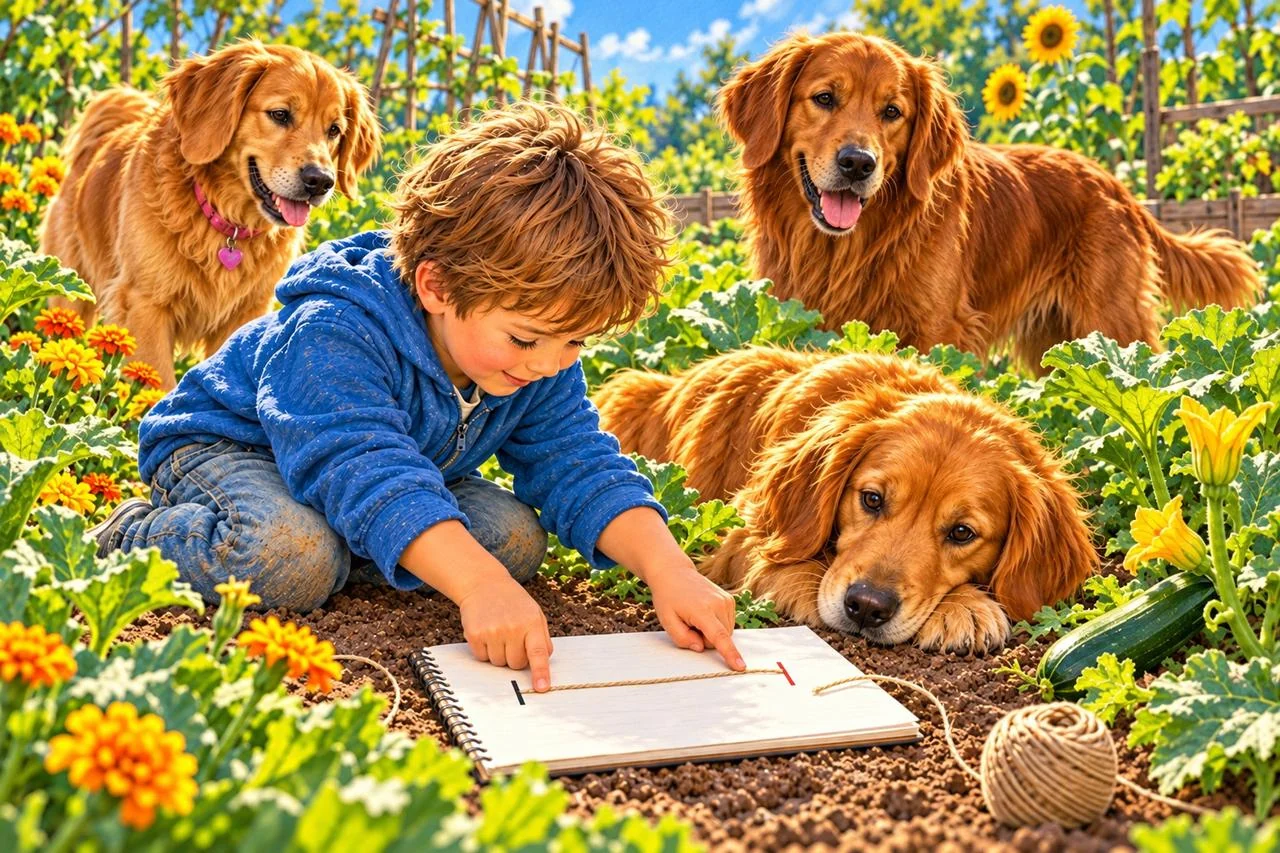
One morning our zucchini reached past the spoon. The boy held the end of a long string at the stem and ran it along the squash. Where it reached the blossom tip, his mother made a black mark. He tucked the string into his notebook.
The next morning he lined it up the same way. Enzo put his silky head on his paws. The black mark stopped short of the tip.
“I think the string shrank,” he said.
Duke looked at the loose end. “Or something else happened.”
His mother made a red mark where the tip reached now. He stretched the string across his notebook. Yesterday’s zucchini would have stopped at black. Today’s went on to red.
“Shall we see where it gets tomorrow?” he asked. His mother felt the smooth green skin. “This one’s just how I like it for supper.” She cut it at the stem and handed it to him.
He weighed it in his hand. “But which part did I eat last time?” Enzo touched his nose to the red mark. The boy ran his finger along the string. “Oh! The whole green part.”
The next time we saw him, he’d drawn a row of green-rimmed circles in a frying pan. “I ate both end pieces,” he told Enzo. “Dad got the middles.”
He tucked the string between those pages. Back in the plot, another yellow flower had opened.
This time he knew where to look.
REMI’S LESSON
Measure the same part each time. Keep the old mark so you can see what changed.
CHAPTER 15 / LATE JULY · THE PRAIRIE
A Door in the Sand
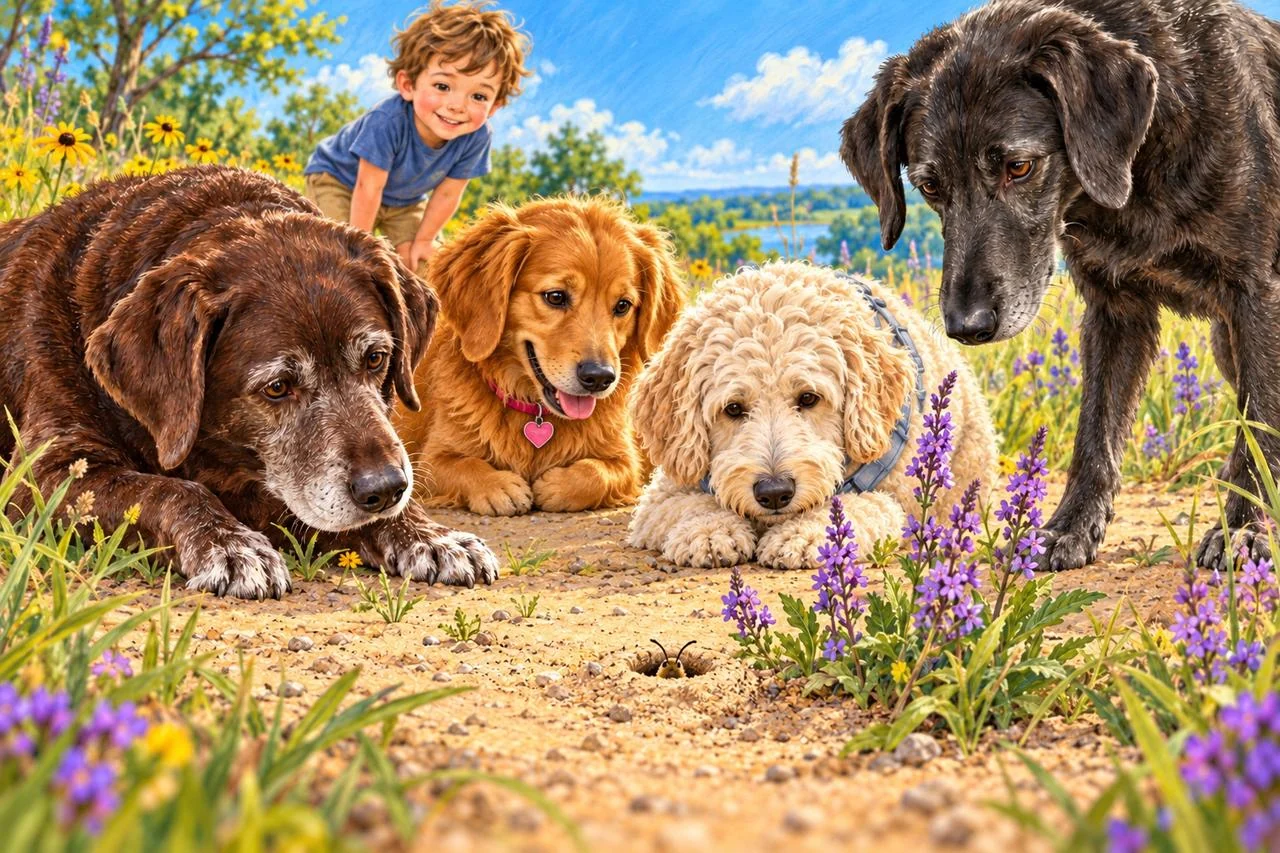
The little gardener’s mother wanted to draw a thank-you for the bee. Her sketch from the squash patch showed one fuzzy back. In the prairie she saw a bee with dust on its legs and turned to the same notebook page.
“Hold on,” said Kimber. “This one keeps coming back to the same purple flowers.”
Tikka, the dark-coated dog who lives with Kimber, watched from the path. “And when it leaves them, it goes down.”
Rupert had plenty of energy left in him, but this was worth stopping for. He spotted a hole in the bare sand. The bee disappeared into it. Rupert tucked his front paws under his chest. I sat on mine. Digging was usually one of the services we offered.
Rupert’s human followed his gaze and found the hole, too. In my human’s field guide we saw a bee known from this prairie. The vervain mining bee digs in sand and gathers pollen from vervain. A mother bee can carry that pollen underground for her young.
“Is that who went down this hole?” Kimber asked.
“We saw where it went,” Tikka said. “I didn’t get a good look at its face.”
She turned to a fresh page. She drew the purple flowers, the sandy door and a question mark. As Rupert watched, two antennae poked out.
We felt ridiculously pleased to be there when somebody came to the door.
REMI’S LESSON
A patch of bare sand can be somebody’s front yard.
CHAPTER 16 / LATE JULY · THE FLOWER PLOTS
Two Dogs Named Remi
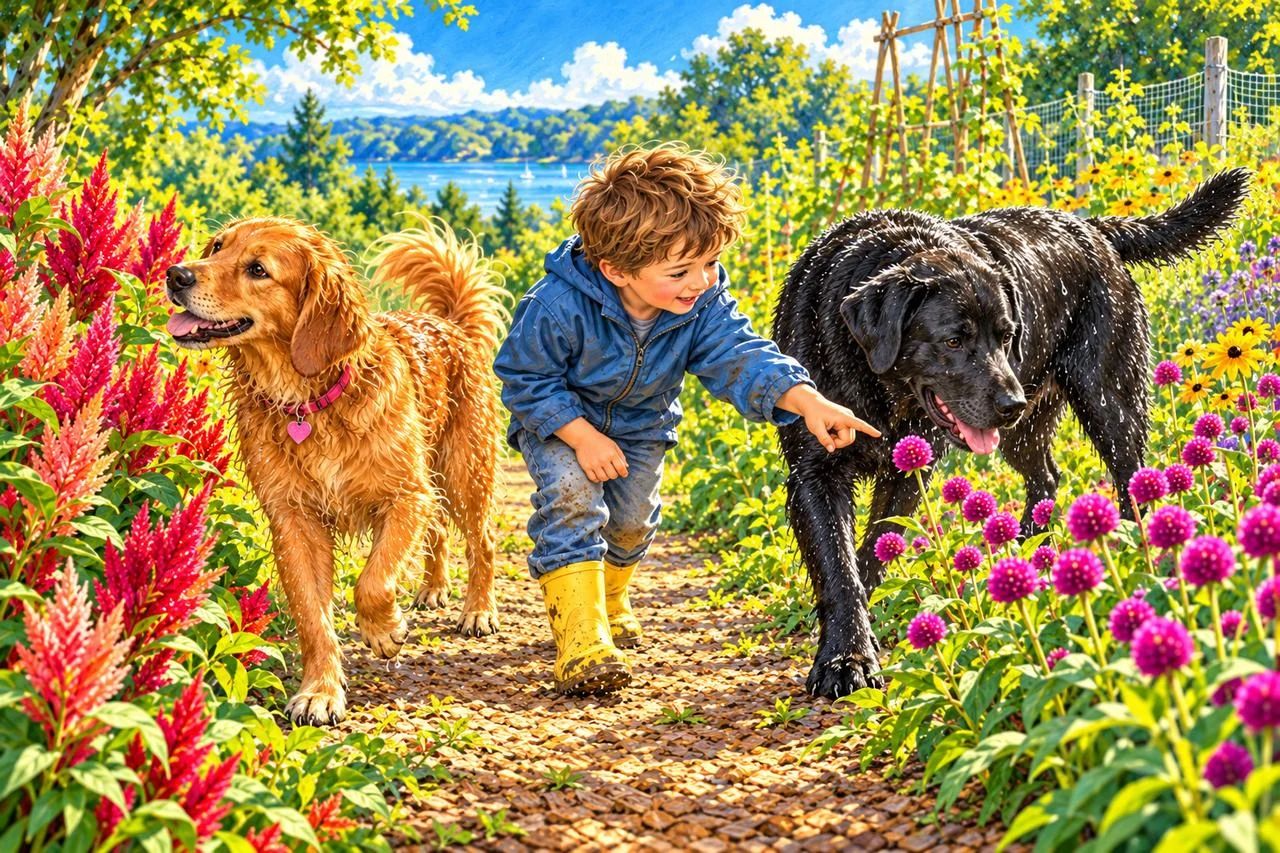
“Remi!” my human called from the garden path. Two wet dogs showed up.
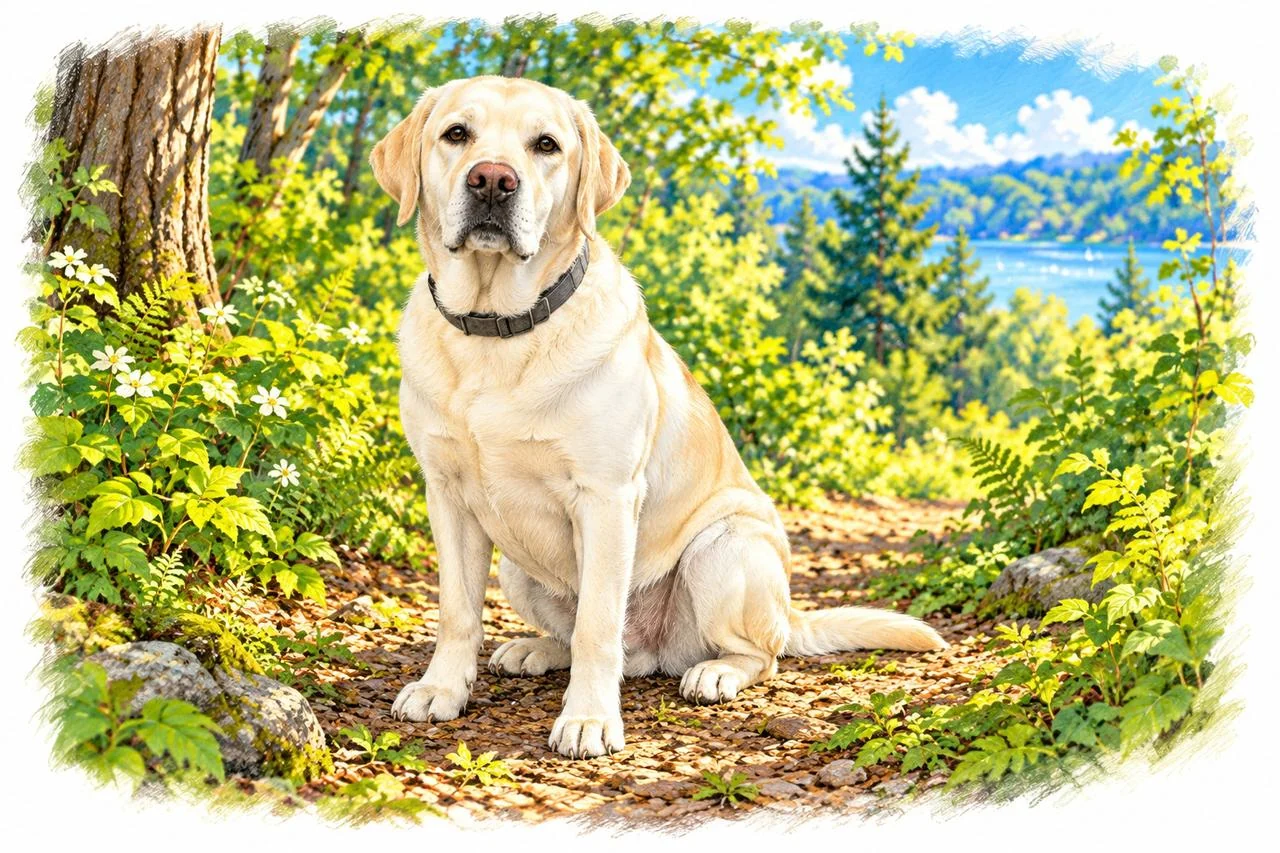
I was the golden one. The other Remi was a black Lab with broad shoulders and a square head, bigger than me and almost as big as Sunny, our yellow Lab friend. The sun made his wet black coat shine. We’d both been swimming in the creek. We both loved chasing balls, too.
“You’ll have to be more specific,” I told my human.
The little gardener had a problem like ours. He wanted a pink flower for his jar. He pointed one way. The flower gardener reached the other way. There was pink on both sides of the path.
The black Lab followed the boy’s finger. “That one looks like a ball on a stick,” he said. It was globe amaranth. The flower gardener turned a cut stem so we could see the little papery pieces packed together in a globe. Tiny flowers peeked out between them.
I looked across the path. “Mine looks like the end of my tail.” The celosia grew in feathery plumes, some raspberry red, some the color of peaches.
The boy made a fist for the globe and spread his fingers for the plume. This time his gardener knew exactly which pink he meant.
Then somebody called “Remi!” again. Both of us went.
There was always the chance they meant the one who liked a ball.
REMI’S LESSON
Two things can share a color or a name. Look for a shape that tells them apart.
CHAPTER 17 / LATE JULY · THE GARDEN PATH
The Case of the Wet Feet
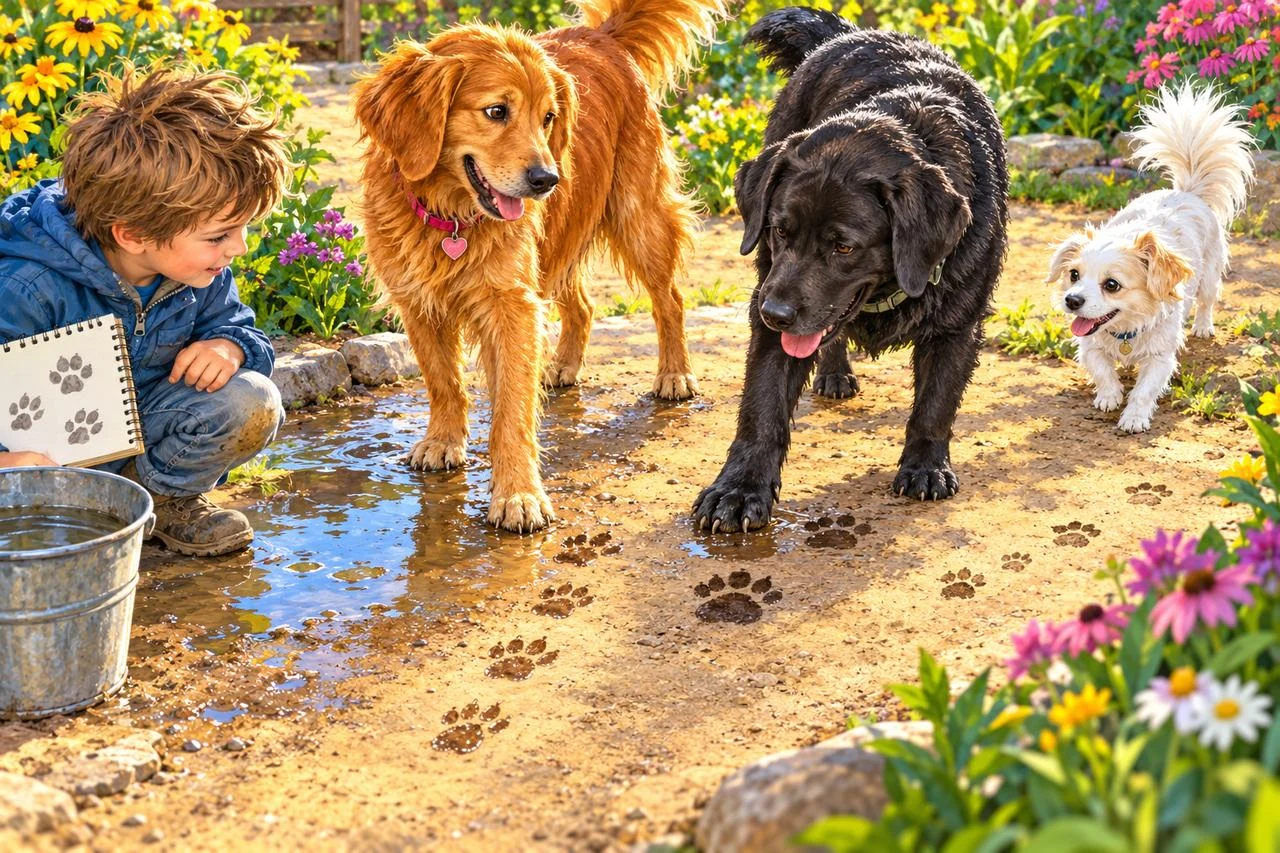
Wet paw prints led away from the water pail. I followed them with the black Lab Remi. Two dogs who had already been swimming were probably a poor choice to investigate a wet path. Still, there we were.
The little gardener pointed at the big prints. “Those have to be yours,” he said to the Lab.
The Lab put one broad paw down beside them. It made a much bigger print. I put mine down next to his. Mine was too big, too.
Ruby came along behind us with her little cream tail tipped up like a question mark. We looked at her feet. Dry as toast.
“Did anybody see who made the tracks?” I asked.
The boy shook his head. He had come out of the tunnel after the tracks appeared. The Lab lowered his square head. The trail of prints got fainter as it went, until the last one was only two toe marks. Whatever had made them had been drying off.
I had an idea. I stepped into the shallow puddle beside the pail, then walked away on a dry stretch of path. Four good prints. Two faint ones. Then nothing the little gardener could draw.
“Where did you go?” Ruby asked. I was standing right in front of her.
The boy laughed. “I know where your prints went. I still don’t know who made the first ones.” He drew the two sets on his page, and beside the first set he left a space for a name.
The Lab sniffed the pail. “If anybody wants one more set, I’m available.”
REMI’S LESSON
A trail can disappear even when the animal that made it is standing right there.
CHAPTER 18 / AUGUST · THE PRAIRIE PATH
Somebody Ate the Clue
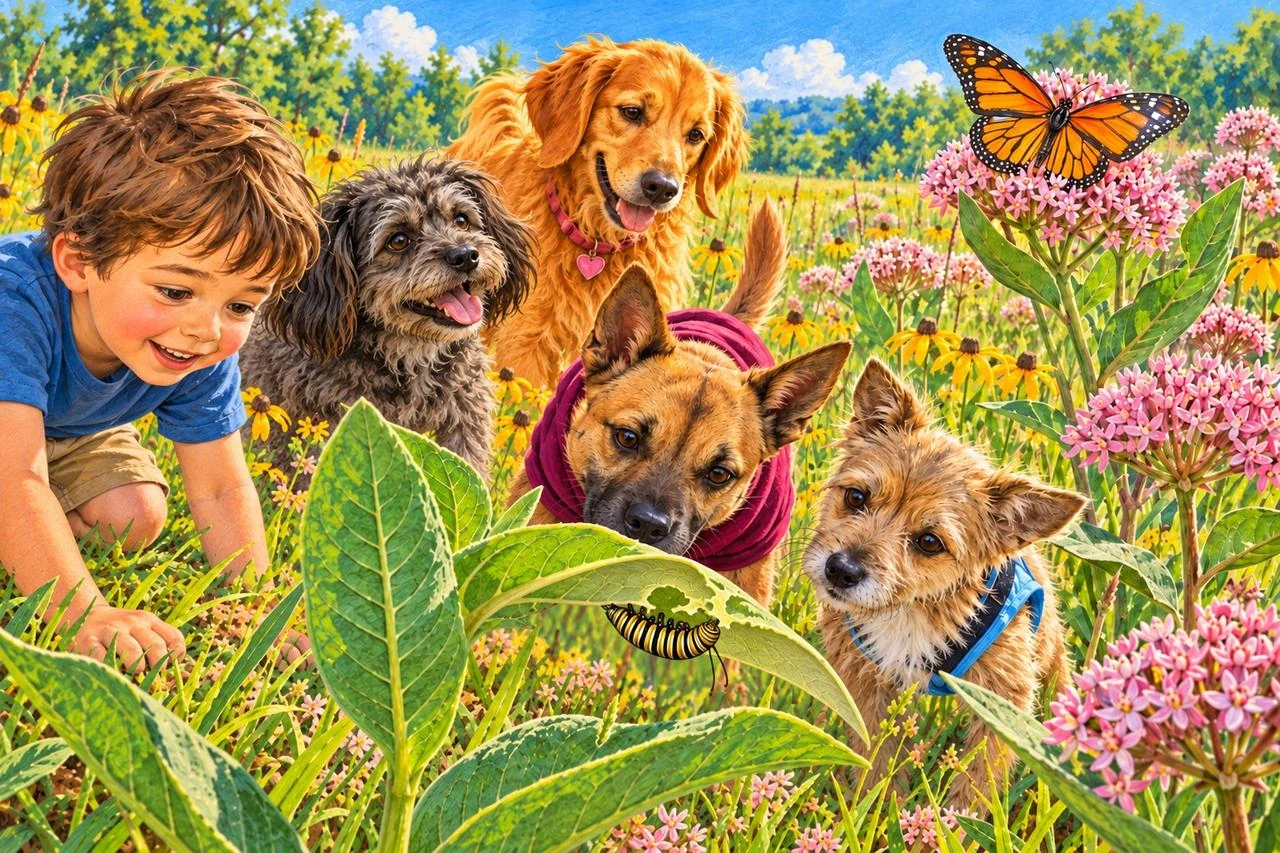
Miru stopped beside a milkweed on the prairie path. The little gardener had been walking with his eyes on the butterflies. He came back to see what had stopped Miru. Someone had taken bites out of a leaf.
“Maybe it’s the bee with the big appetite,” I said.
Gizmo and Yoda split the looking between them. Gizmo watched the top of the plant, where several pink flower clusters still smelled sweet. Yoda waited for the wind to turn a leaf.
There was the diner, upside down. A caterpillar striped in black, white and yellow was shaving off the leaf in tiny green bites. It stopped chewing long enough for us to see its head, then ate the part we’d been admiring.
Yoda’s human had been aiming a camera at the blossoms. Now the camera tipped down. The little gardener leaned sideways, just as Yoda had. “I can see its mouth!”
“Monarch caterpillar,” Gizmo said. Up above, an orange monarch butterfly unrolled a thin tube into a flower and sipped nectar. The caterpillar could go on eating leaves all day without finding that drink.
“Same kind of creature,” Miru said, watching first the striped one and then the orange one. “Different mouths?”
Different mouths and different meals. A caterpillar chews. After its turn inside a chrysalis, the butterfly that comes out can sip. The orange visitor above us had once been a caterpillar, too.
A little piece of milkweed leaf landed on the path. The little gardener left it there and made nibbling noises all the way back to the gardens.
We agreed he made a pretty good caterpillar.
REMI’S LESSON
A monarch caterpillar eats milkweed leaves. A grown monarch sips nectar from flowers.
CHAPTER 19 / AUGUST · THE COMMUNITY GARDENS
The Flower That Blinked
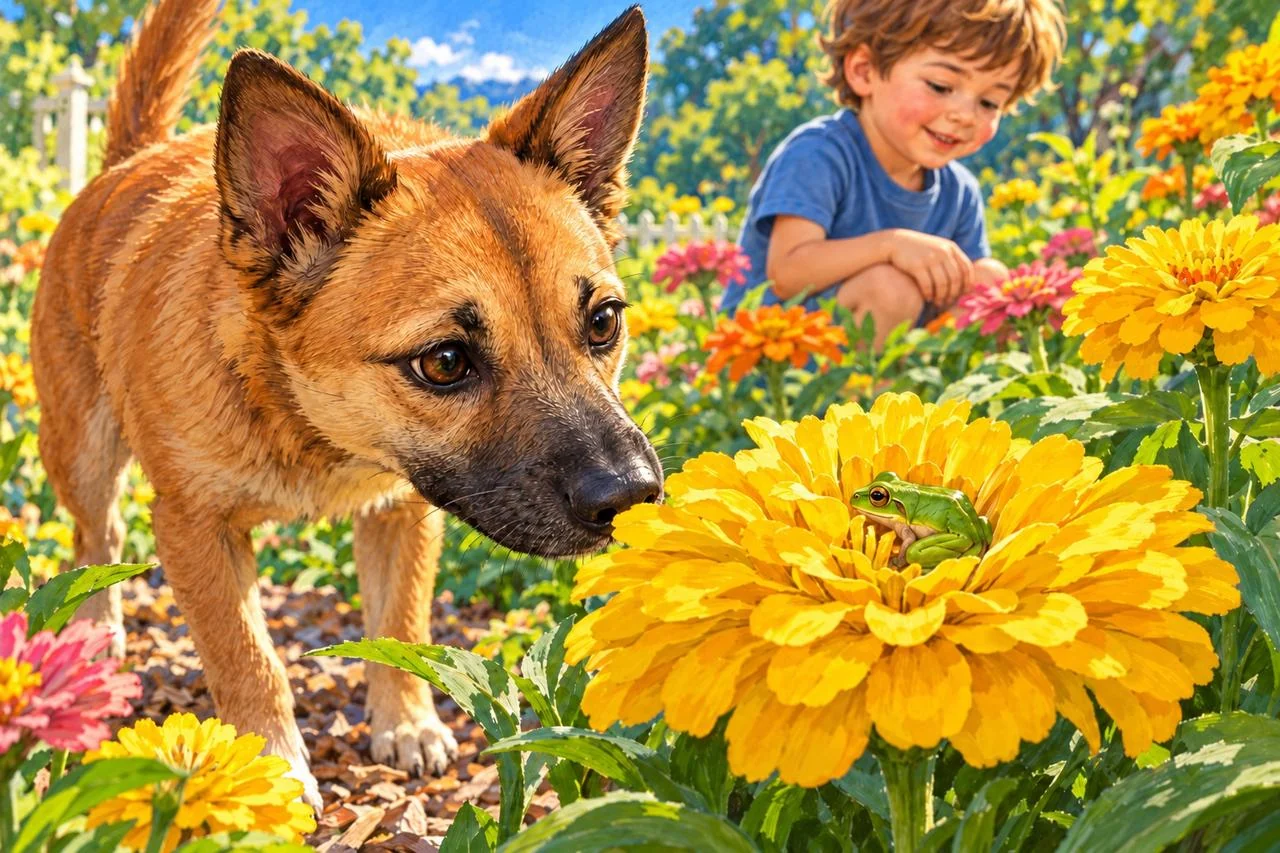
Miru found a green pea in the middle of a yellow zinnia.
“How did a pea get up there?” I asked.
The pea blinked.
Miru’s human bent down beside us. A little green frog was tucked into the petals, with its chin on the gold as comfortably as mine rests on my human’s shoe. The flower gardener lowered her scissors. She chose a different zinnia for the jar.
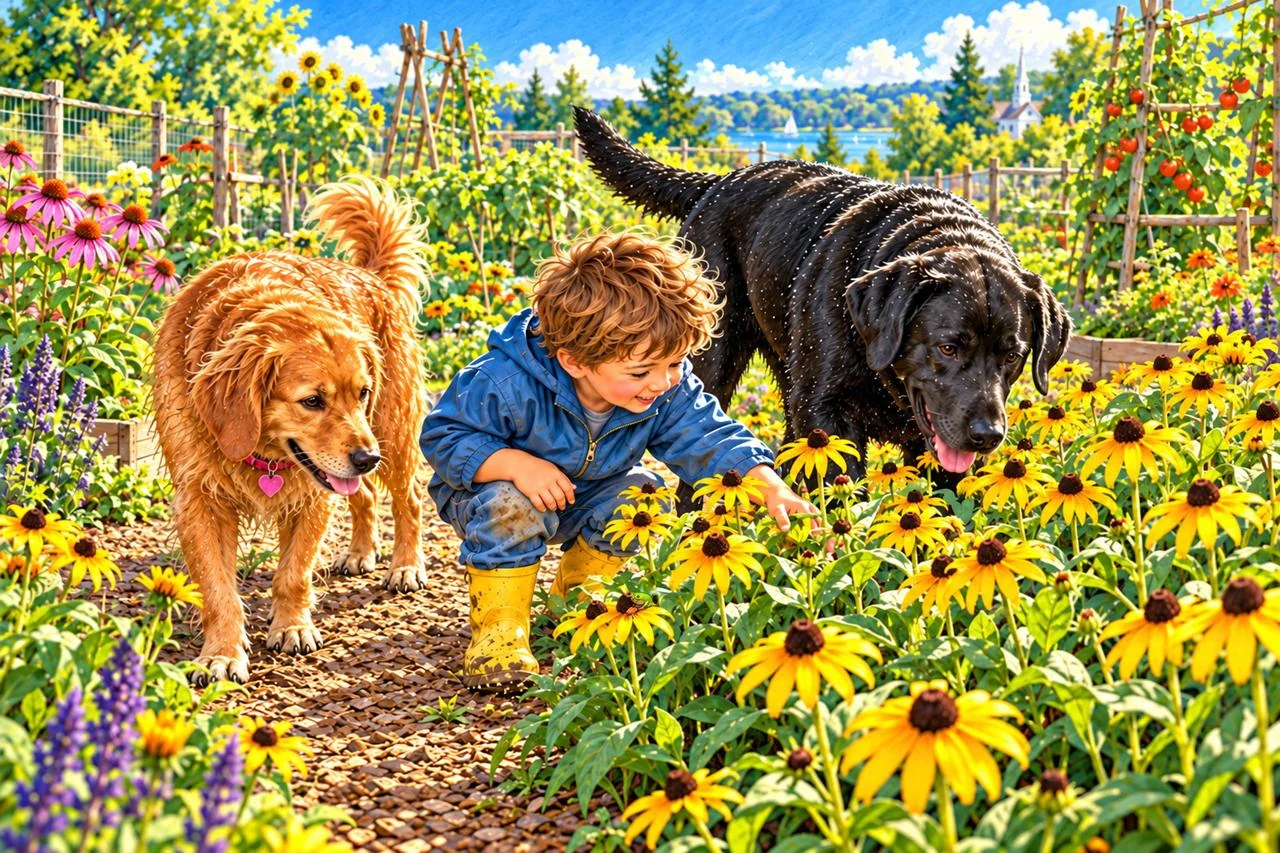
Another morning the black Lab Remi and I stopped at a whole bed of yellow daisylike flowers. Each had a dark middle that stood up like a coat button. The little gardener knew their name. “Black-eyed Susans. Should we look for another pea?”
The Lab’s square head went still. Just above one of those dark buttons sat a green frog. Was it the frog from the zinnia? It hadn’t brought a name tag.
Two soldier beetles walked across the button below it. Their soft orange wing covers had black marks near the ends. A beetle stepped among the tiny flowers in the center. Visiting beetles can carry pollen on to another bloom.
“And what’s the frog doing?” asked the Lab.
We watched. It tucked one foot under its belly. The little gardener drew the foot exactly where it was.
Sometimes a frog gets to sit for its portrait without having to explain itself.
REMI’S LESSON
One flower can hold a resting frog and a hungry beetle. Watch what each one actually does.
CHAPTER 20 / AUGUST · THE GARDEN PATH
A Tiger Among the Cosmos
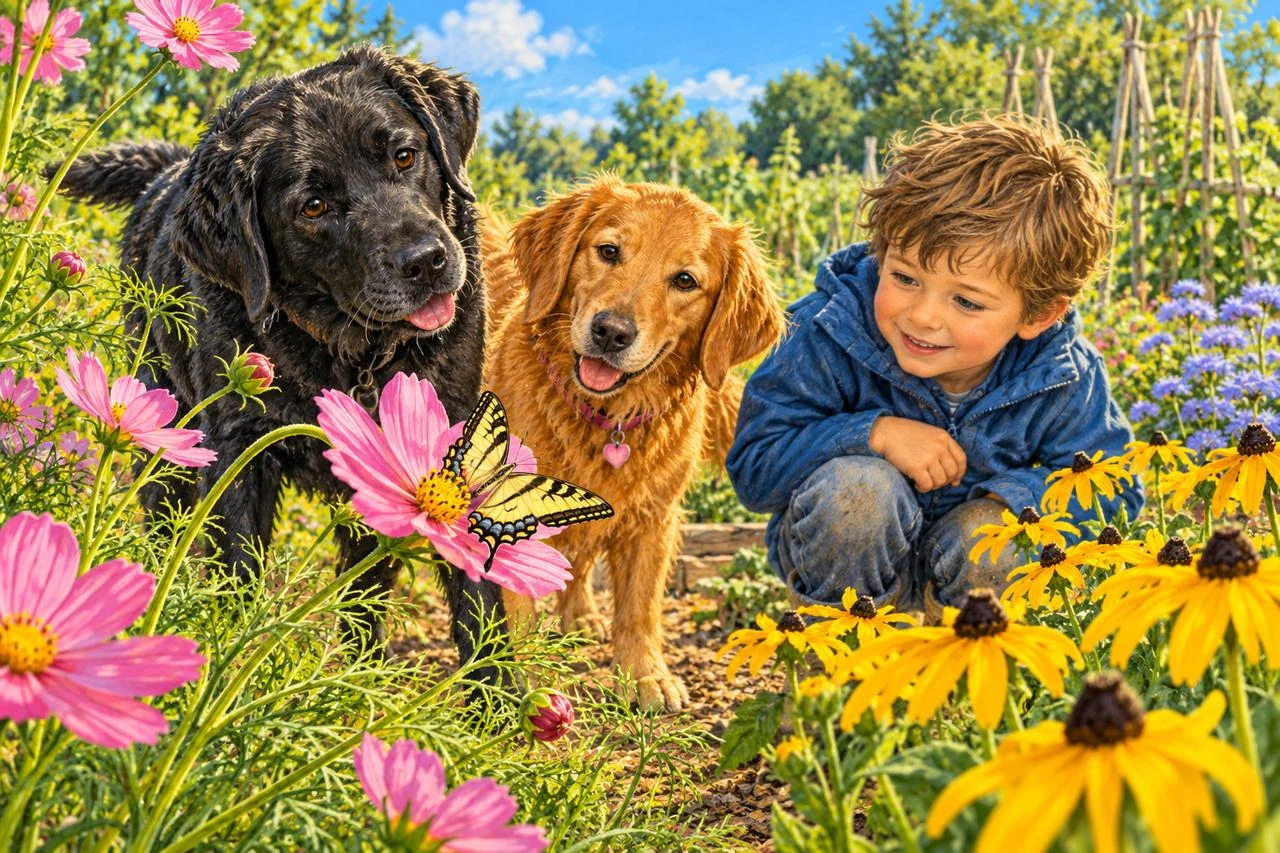
Something yellow lifted out of the black-eyed Susans. For a moment I thought one of the flowers had come apart.
The black Lab Remi tipped his head to follow it. His human had been looking at the flowers that stayed put. Now all three of us watched the yellow thing land on a pink cosmos. Its stem bent, and the leaves below it trembled like fine green threads.
“A yellow monarch!” the little gardener said.
The visitor opened its wings. Black stripes crossed the yellow. A narrow tail stuck out at the back of each hindwing. The boy opened his notebook to our orange monarch. Dark lines followed that butterfly’s wing veins. He looked from his drawing to the two trailing tips.
“Tiger swallowtail,” he read from the butterfly guide. This time he drew the outline before he reached for a crayon.
The butterfly dipped its long tongue into the cosmos. When it lifted off again, a breeze slid through a patch of blue fluff farther down the row. The flower gardener thought those clusters looked like flossflower, also called ageratum.
“Did it land on that tall sunflower?” the Lab asked. We could see broad leaves there, but no open flower to settle even that part of the question.
I’d lost it, too. Our two noses went in opposite directions. The little gardener kept watching the pink cosmos.
Its stem had just started to bend again.
REMI’S LESSON
When a butterfly lands, look at its wings’ edges as well as their color. A pair of little tails makes a good clue.
CHAPTER 21 / AUGUST · THE WOODS AT DUSK
The Flowers on the Late Walk
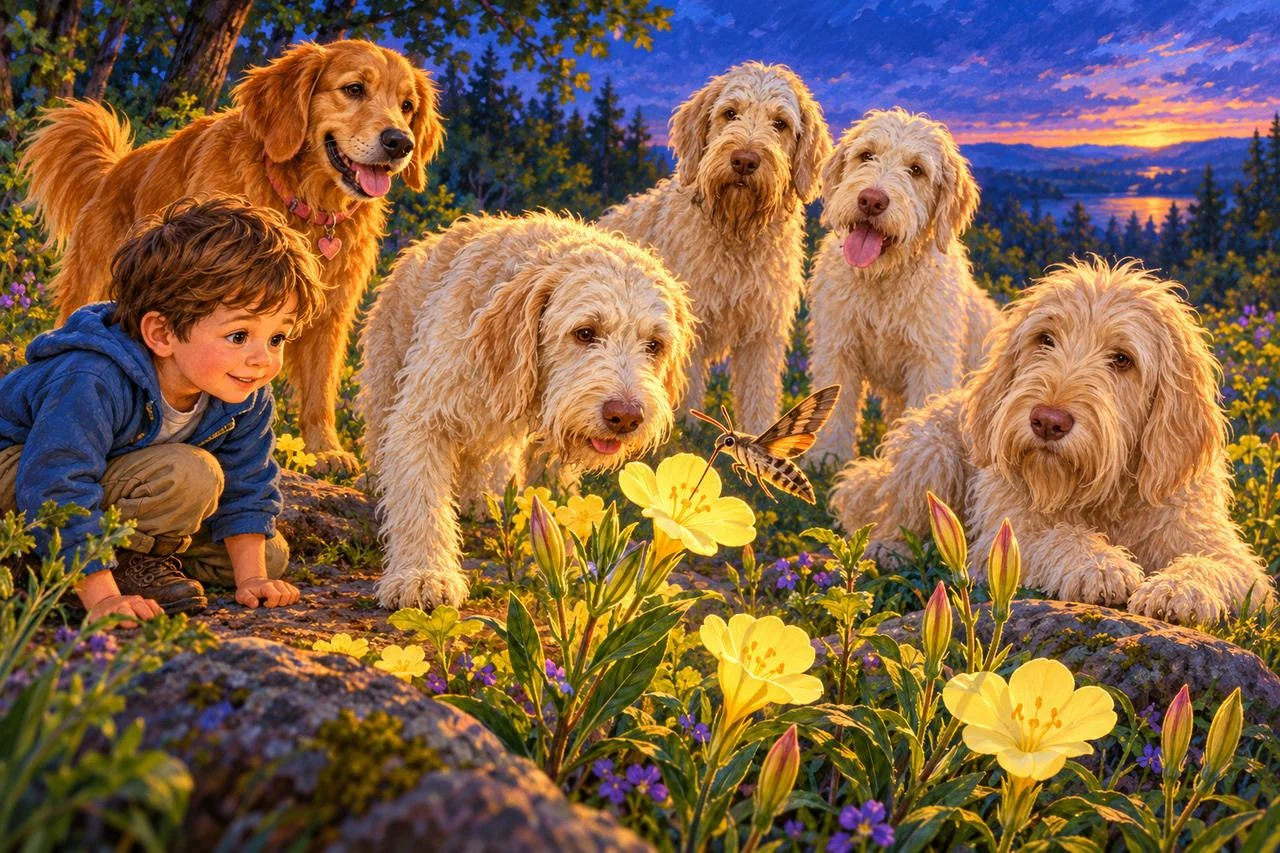
Nella and the three littermates, Umberto, Bellini and Alba, do their woods tour in the evening. I usually have plenty of news for them. That night, when I began telling them about my morning bees, Alba interrupted.
“Remi, you’re standing in front of the good part.”
I took one step sideways. At the edge of the woods a pale yellow evening primrose was opening. Umberto had picked one bud to watch. A seam split down its side. Four petals worked loose like a dog getting its head out of a sweater.
“There,” whispered Bellini, whom the family calls Bell.
I saw something flutter and lost it against the trees.
“Look at the flower instead,” Nella said.
A moth hovered at the bloom. A long tongue reached into the yellow cup. At the next flower, the moth brushed the middle again. A little pollen could travel on that soft body just as it could on a bee.
My human had been putting the camera away for the night. Now it came out again. Alba sat beside the next bud. This time my human was watching when the first petal came loose.
“Does this happen while I’m home having supper?” I asked.
“Bring your supper tomorrow,” Nella said. “I’ll save you this spot.”
Tomorrow I’d tell the morning dogs about the moth.
Tonight I wanted to watch one bud all the way from green seam to yellow cup.
REMI’S LESSON
Visit at a different hour and you may meet a different flower or a different visitor.
CHAPTER 22 / LATE AUGUST · THE FLOWER PLOTS
The Snapdragon Opens Wide
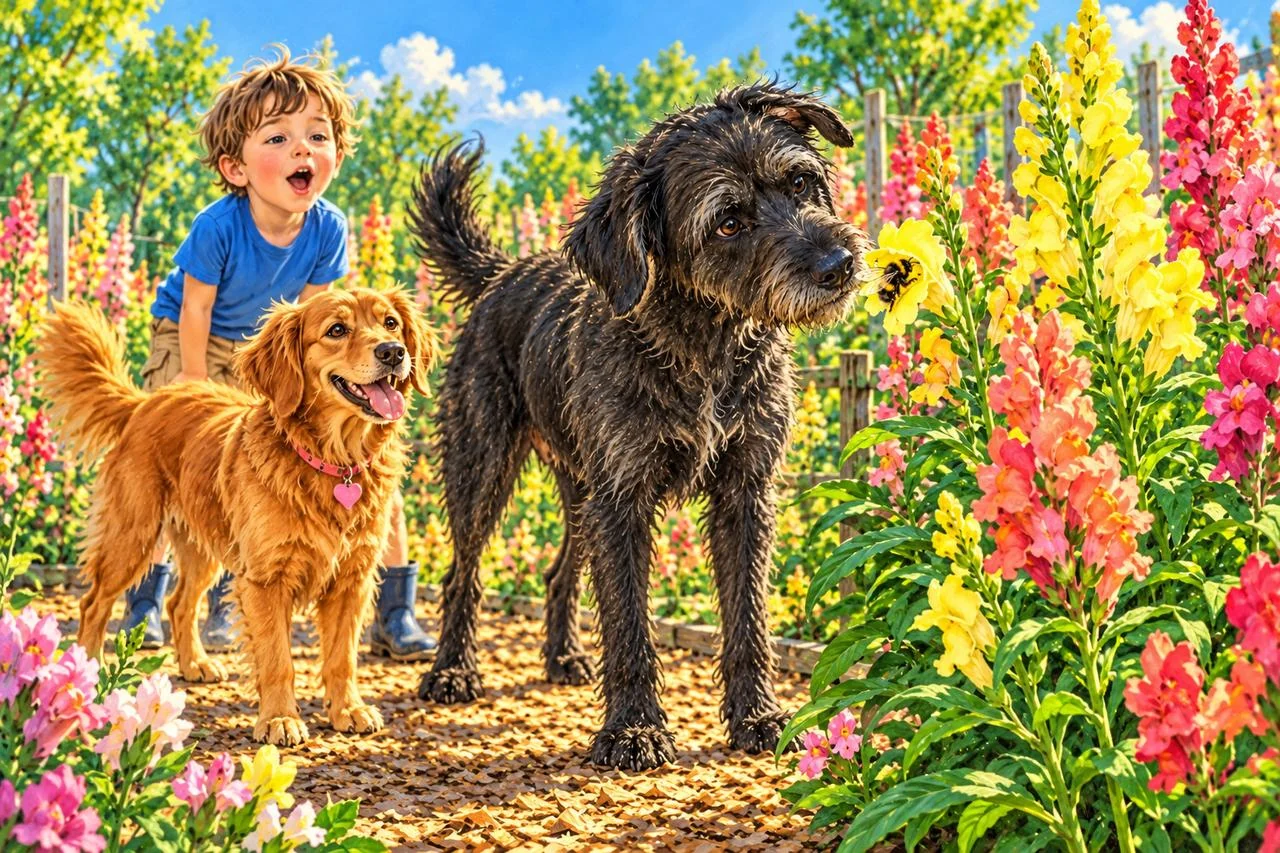
Asher was looking right at a bumble bee when a yellow flower swallowed it.
A muffled buzz came from the flower. Asher turned an ear toward it. Then the bee backed out and landed on the next flower. Its weight pressed the lower lip down. The blossom opened, the bee crawled in for nectar, and the lip sprang shut behind it.
“Snapdragon,” Asher said. “I wondered what the dragon part was for.”
Asher’s human crouched beside us and filmed the next visit. When the flower gardener played it back slowly, the little gardener opened and closed his own mouth along with the flower.
The pink bloom at the front of the next row stayed open. Its petals curled like a rose, above long buds and smooth blue-green leaves. “That looks like lisianthus,” the flower gardener said. The boy tried the name one piece at a time and left space to check the plant label.
Behind the row were dark burgundy heads on slender stems. Asher thought they looked like little pincushions. Perhaps they were pincushion flowers. We’d need a closer look at a bloom and its leaves to be sure.
The little gardener drew a question mark beside them. Under the snapdragon he drew an open mouth with a bee sticking out. Every time he showed somebody the picture, he did the mouth.
I did the buzz.
REMI’S LESSON
Watch a bee land on a snapdragon’s lower lip. The landing is part of how the flower opens.
CHAPTER 23 / LATE AUGUST · THE FLOWER GARDEN
A Bouquet on One Stem
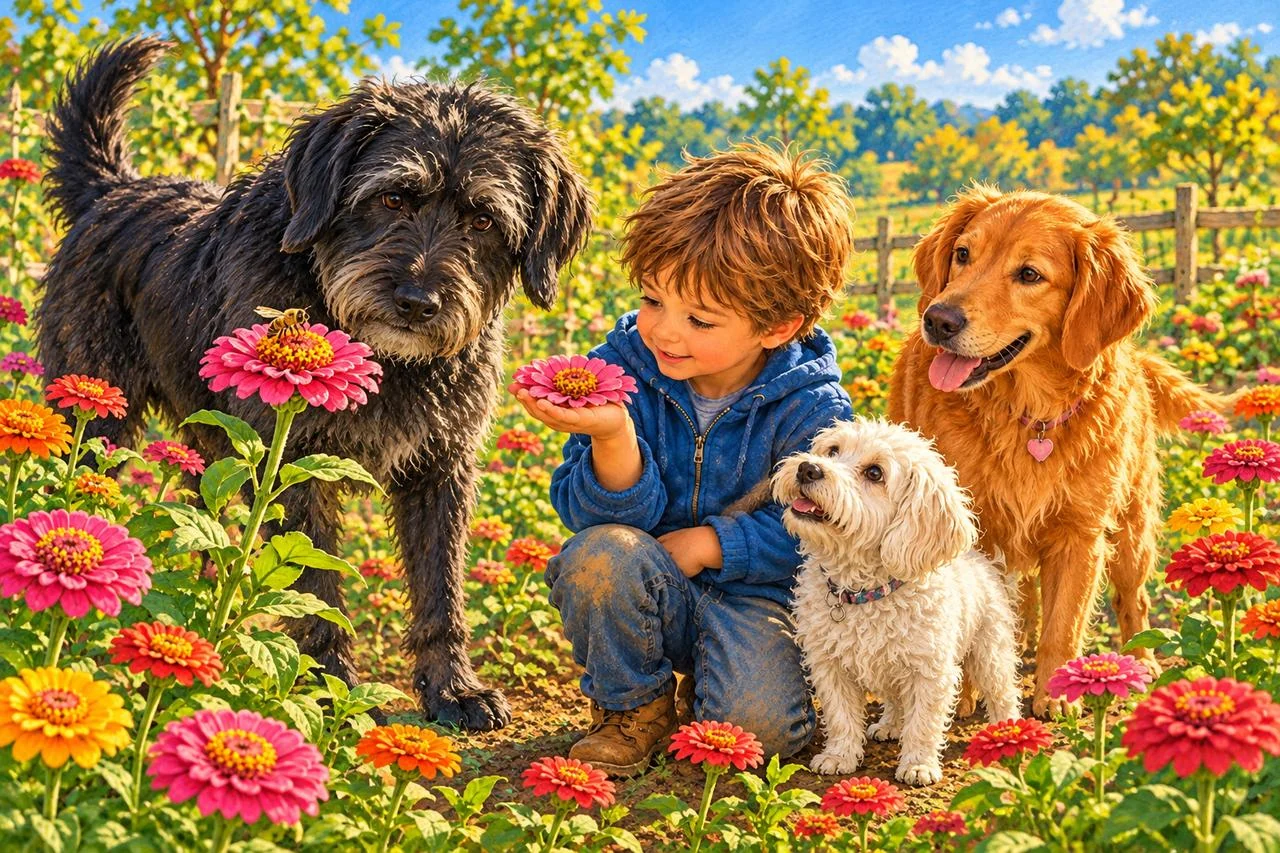
The flower gardener was cutting bouquets when the little gardener arrived with an empty jar. “I want to say thank you to my mom,” he said. “She waters when I’m at school.”
“How many flowers?” she asked. He held up one finger, then looked at the globe amaranth as if he suspected a trick.
She laid a pink zinnia across his palm. In its middle stood a ring of tiny gold stars.
Asher lifted a shaggy face toward a second zinnia, still on its stem. A bee was walking around the middle. The flower gardener paused with her scissors open.
Winnie had joined us that morning. “Oh, I know this game,” he said. “We played it on the dogwood.”
“On the dogwood you could see all the little stalks,” Asher said. “Here they’re packed so close I thought the whole thing was one.” Each time the bee stopped walking it dipped into a different tiny flower.
“I cut these every morning,” the flower gardener said to Asher’s human. “It took your dog to get me to stand here long enough to see that bee go all the way around.”
The little gardener pressed his nose to the zinnia in his hand. It came away with a yellow dot. “So I did bring a bouquet,” he said.
We found his mother digging potatoes. The boy drew one with specks of dirt still tucked in its eyes. His mother wiped her hands and slipped the zinnia through a buttonhole. All morning people told her they liked her flower.
The little gardener corrected every single one of them.
REMI’S LESSON
The center of a zinnia holds many tiny flowers. Watch where an insect puts its feet.
CHAPTER 24 / LATE SUMMER · THE FLOWER GARDEN
The Note That Flew
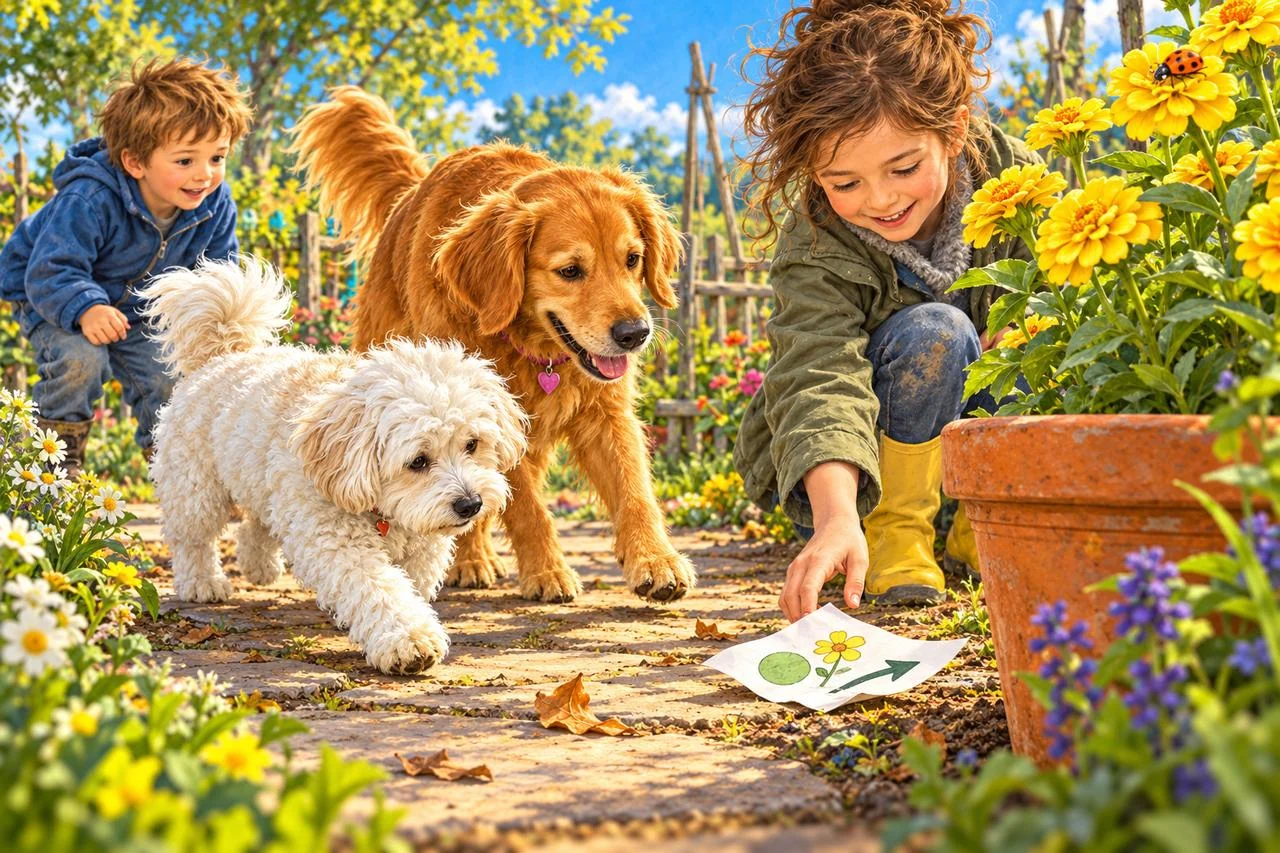
The little gardener had drawn a card for a girl who came to the gardens after school. He wanted her to see the frog in the zinnia. While he was reaching for a green pencil, the wind lifted his card right out of the notebook.
Two things sailed across the path. I chased the crinkly brown one. It was the papery skin of an onion. Winnie followed the card to a flowerpot just as the girl came along.
She picked it up. There was one green circle near one yellow circle and a very large arrow. She looked at the yellow bucket. She looked at a green watering can.
“That way?” she asked. The arrow had turned in the wind.
The boy looked where she pointed. That way lay the compost, where nobody remembered seeing a frog. He ran back for two more pencils.
He drew layers of petals around the yellow circle. He gave the green circle two little eyes. Around both he drew the rim of the pot that stood beside the zinnias. Now the girl recognized the pot. She walked over with her scissors tucked in her pocket.
The yellow flower was empty. Winnie sat beside it anyway. A beetle stepped out where the frog had sat.
“Did I miss it?” the girl asked.
“You missed the frog,” said the boy. “I missed whatever happened before it got there.”
The girl drew the beetle and wrote today’s date. The boy drew a curl of onion skin in his notebook to remind him which way the wind had blown.
I thought that made my half of the chase quite respectable.
REMI’S LESSON
Two people can visit one flower on different days and both come home with a true picture.
CHAPTER 25 / SEPTEMBER · THE PRAIRIE EDGE
How Far Can Lunch Take You
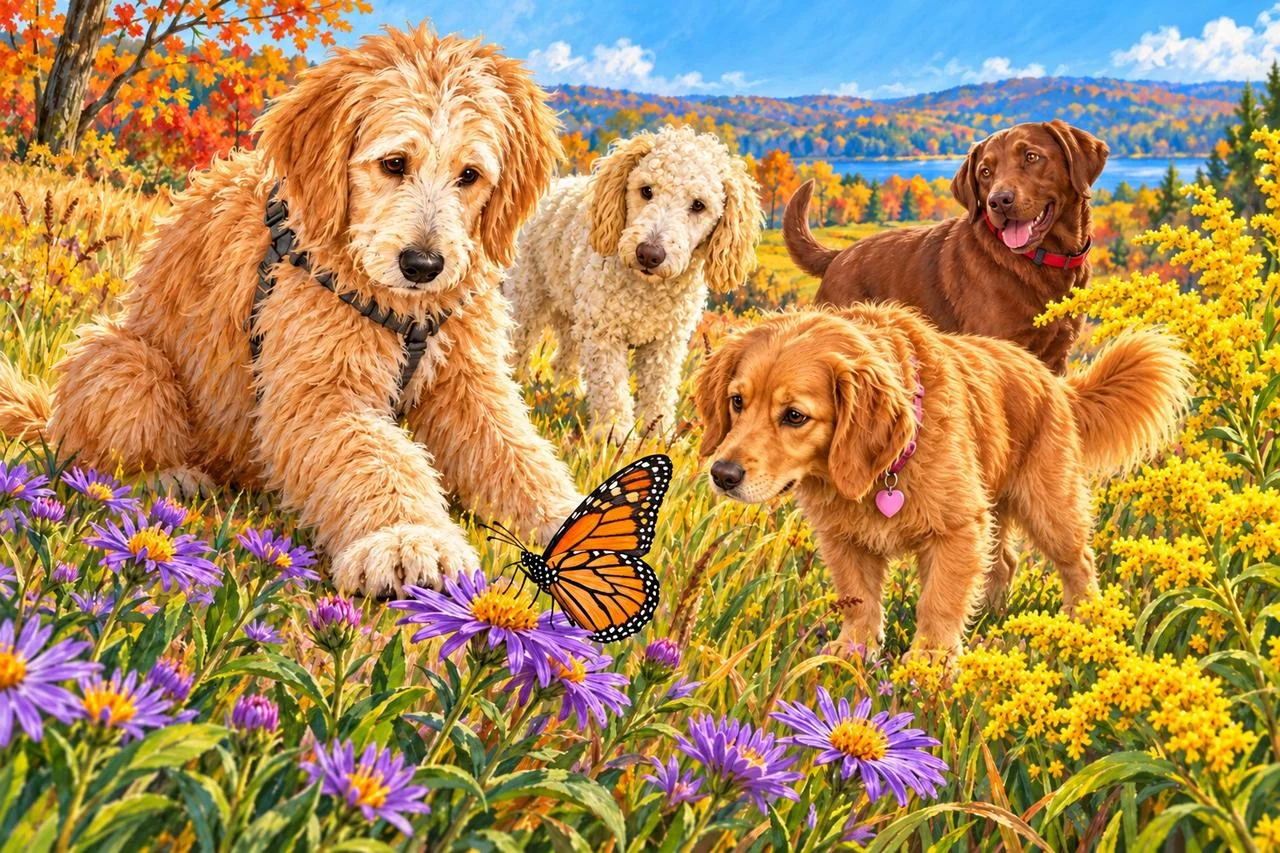
By September you could play a whole game of spot-the-red-tomato without leaving the path. Out on the prairie an orange wing caught my eye. The boy recognized the monarch’s black veins. His striped yellow butterfly had a page of its own.
Finnegan Gilbert waited for a monarch to fly across a stretch of prairie. “I could follow that one,” he said.
“All the way to Mexico?” Tasha asked.
Finnegan sat down. He was a very big puppy, but he still had to be home for dinner.
The monarch landed on a purple aster. Finnegan’s human waited beside him. From there we could see its tongue unroll like a little watch spring. “The monarchs that leave Minnesota in fall can fly all the way to the mountains of central Mexico,” Tasha told me.
Choco looked back at the goldenrod. Yellow sprays reached over the path, and each spray carried more tiny flowers than I could possibly sniff before somebody called me home.
“It can fill up on nectar here and find supper somewhere I’ve never even smelled,” Choco said. Finnegan’s human drew our butterfly with its tongue unrolled. “I came to see the wings,” his human said. “I never thought to look for the tongue.”
We watched until the monarch cleared the trees. Which way that particular butterfly went after that, none of us could see. Finnegan walked home beside me.
For once he seemed pleased that his own dinner stayed in one place.
REMI’S LESSON
A late flower can feed a traveler headed much farther than the next patch of prairie.
CHAPTER 26 / SEPTEMBER · THE VEGETABLE GARDEN
Whose Supper Was in the Basket
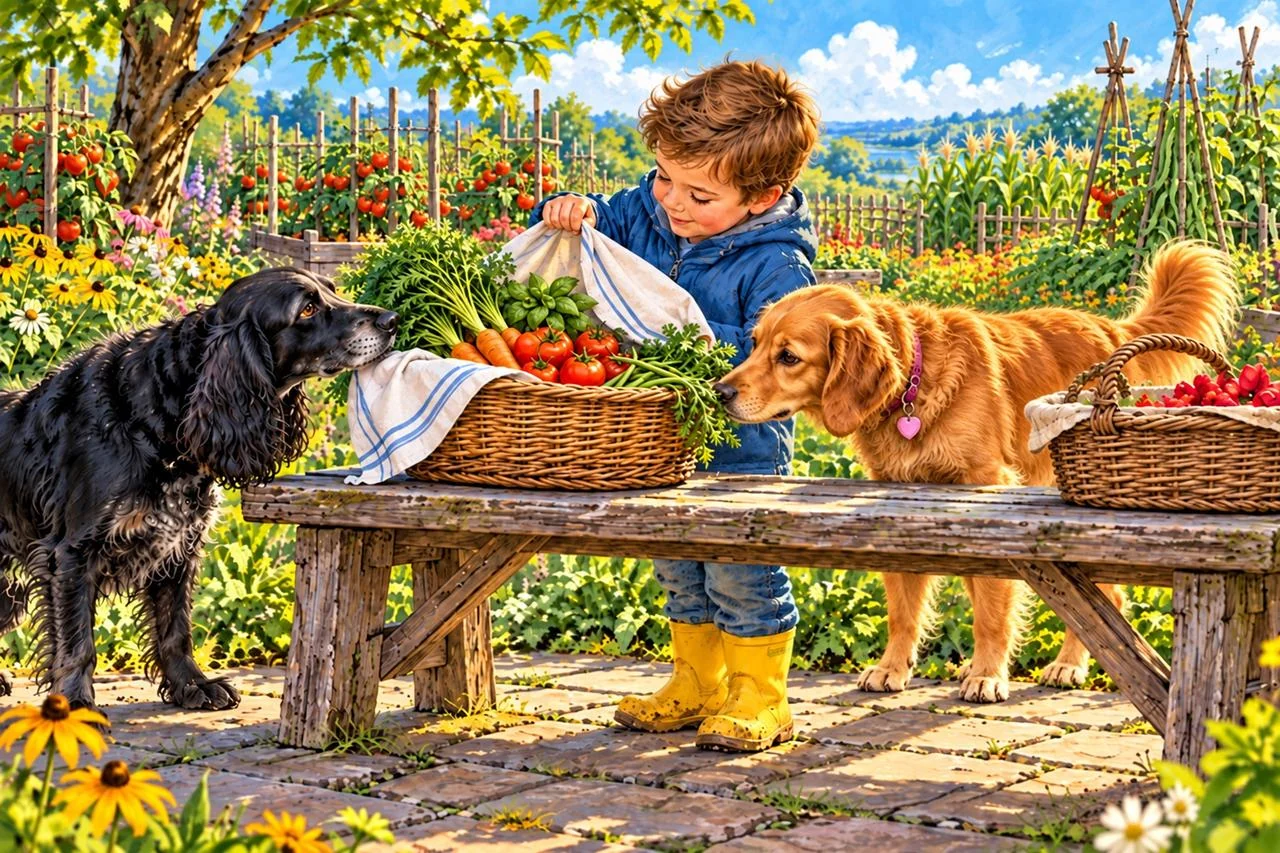
I caught the smell of supper halfway down the path. A basket sat on the bench with a dish towel over it. Bert stopped beside me. His long black ears hung nearly level with the basket rim.
“Tomatoes?” I asked. We’d passed so many on the way in that it seemed a fairly safe guess.
“Could be. Your nose is closer.”
There was a green, sharp smell, and underneath it something sweet. I knew those smells. Unfortunately, the time to remember what you know is seldom right before supper.
The little gardener had been sent to fetch the basket of vegetables. Next to it sat another basket, covered with another dish towel. Both had the same handle. He hesitated.
Bert had a look from the far side of the bench. A green carrot top stuck out from under one towel. Three red petals stuck out from under the other. I went around beside him. From my side both towels had looked plain white.
The boy lifted the cloth over the carrot top. Red tomatoes filled most of the basket. Green beans, two carrots and a handful of herbs filled the gaps. The other basket held a bouquet with the cut ends wrapped in a damp cloth.
“It smelled like both,” I told Bert.
“You smelled both,” he said.
The boy set one basket at each end of the bench. He leaned in and sniffed the space right between them. Then he sniffed each one separately. That sharp green smell came from the herbs. The sweetness came from the flowers. He put his nose over the gap one last time and had both baskets back.
“Did you find our tomatoes?” his mother called. The boy lifted the right basket. Bert and I walked him home as far as the tunnel.
Somebody had to keep an eye on supper.
REMI’S LESSON
Try changing where you stand. Two smells can meet halfway.
CHAPTER 27 / FALL · THE GARDEN BENCH
Which Way Did My Ear Go
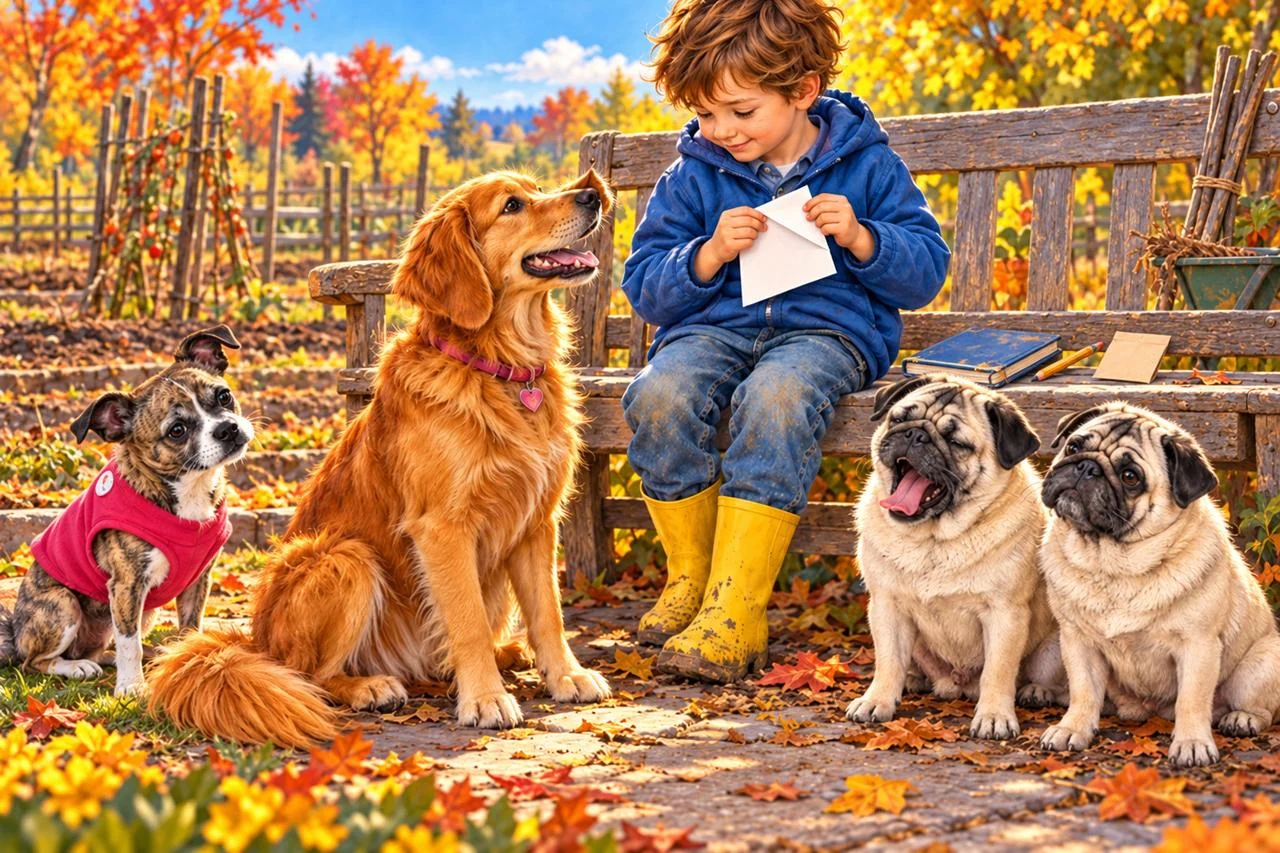
People were carrying tomato cages and bean poles out of the plots. On the bench the boy opened his blue notebook. He wanted my picture on the cover, but the drawing on the old seed packet had worn white right where my left ear folded.
The little gardener tried to draw the ear again. He made it stick straight up. I looked like a rabbit. He made it stick straight out. Now I could have flown south with the monarchs.
Ava came over with Buster and Bugsy. The four of us sat facing the boy. He looked from one pair of ears to the next.
Bugsy’s ears folded close to his round head. Ava tipped hers toward the squeak in the yellow boot. Mine turned, too. The boy got up on the bench and looked down at me.
“It folds back,” he said. “I can see the inside.”
I tried to hold the pose. Buster yawned, which made Bugsy yawn, which made me yawn. My ear went right side out again.
The boy folded one corner of his paper over. It stayed put after he lifted his finger. He traced the little triangle and opened the corner out again. There was the bit of ear he’d lost.
He glued the picture onto his notebook. His mother held it up beside my face. Buster tipped his head at the cover. Then he tipped it at me.
I’ve never had a better review.
REMI’S LESSON
Sometimes folding a piece of paper tells you more than drawing one more line.
CHAPTER 28 / FALL · PLOT CLEANUP DAY
The Last Thing in the Plot
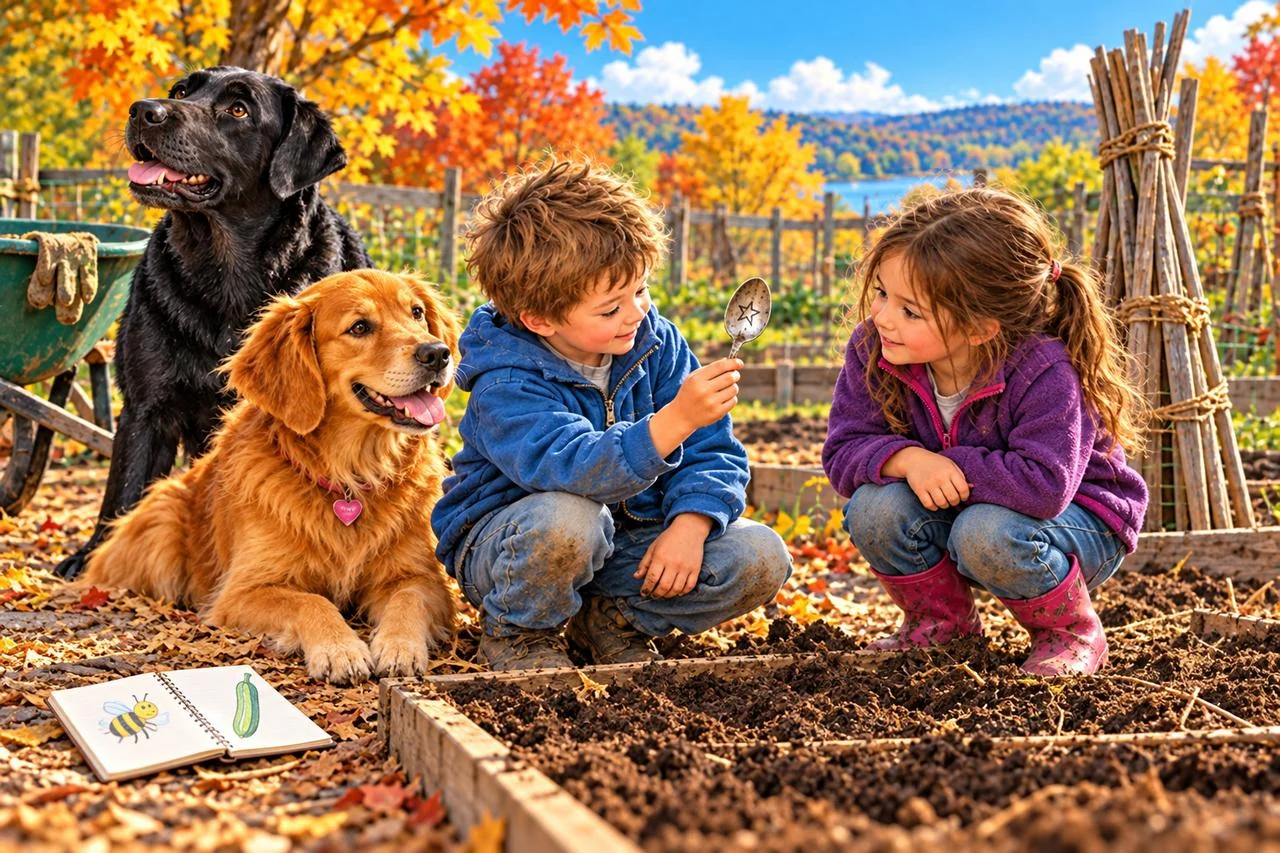
The tomato stakes were tied in a bundle. The bean poles lay beside them. Our squash plant was out, and so were the tall stalks of sweet corn in the next plot. It was time to have the gardens cleared. The boy’s mother took one last look.
“Something shiny,” she said. A silver rim stuck out of the dirt where the zucchini had grown. The boy knew that rim. He pulled out the spoon, rubbed it on his jeans and found his star.
A girl carrying the last of her family’s tomato cages set them down. “Were you growing spoons?” she asked.
“Just the one,” he said. He opened the notebook with my face on the cover.
The black Lab Remi came to see. The yellow boot squeaked. My left ear turned, his square head turned, and the girl looked from me to the drawing. “Hey! That’s her!”
Ava arrived with Buster and Bugsy. The girl had her finger on a yellow flower. “So what did you grow right here?”
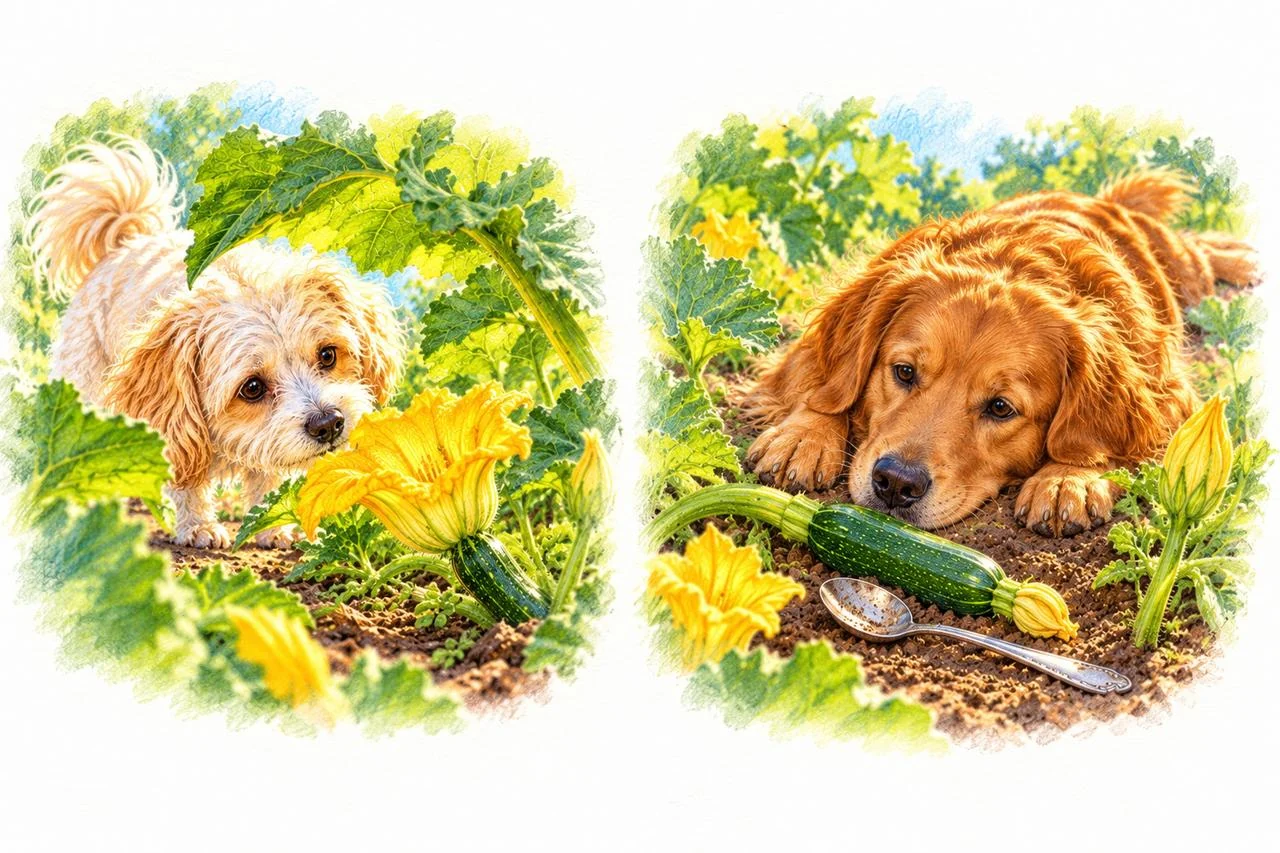
The boy found the drawing of the tiny zucchini Ruby had spotted and lined up the real spoon beside the one Enzo had helped him draw.
“A bee carried yellow dust from this flower to that one. See the little green bit behind it? That’s what grew.” He turned to the frying pan. “I got to eat the end piece.”
The girl tried lining up the spoon herself. He held the book steady for her.
Then he slipped the spoon into the bucket with their tools.
When he carried it away, the plot was empty.
REMI’S LESSON
A whole garden can fit in a notebook if you keep the little things you want to remember.
CHAPTER 29 / AFTER CLEANUP · BESIDE THE GARDENS
A Pocketful of July
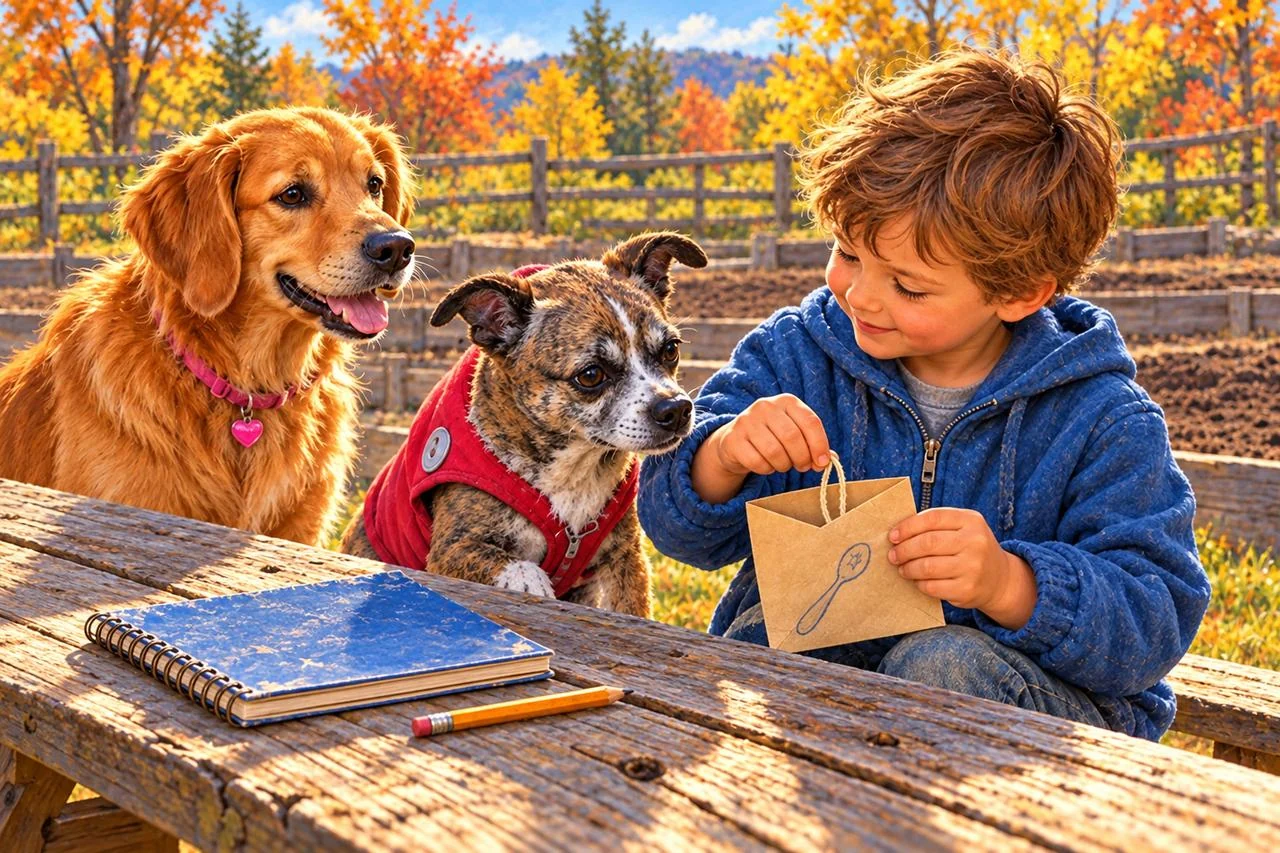
On our next walk the little gardener was sitting at the picnic table, shaking his notebook upside down. A piece of string fell out. Ava sniffed the black mark and the red one a little farther along.
“That smells like his pocket,” she said.
Across the path, the rows were bare. The boy laid the string on his palm. “Mom, if I find this next year, how will I know what it was?”
His mother gave him a little paper envelope. “What would you want to remember?” He looked from the empty garden to the red mark.
“How long supper was before we sliced it.”
He drew the zucchini on the front of the envelope. Along the back he drew the spoon with its star. There was just room beneath the handle for JULY and the year.
He slid the string inside and tucked the envelope into the back pocket of the notebook. This time he could turn the book upside down without losing July.
Ava nudged his knee. He opened to a clean page. Her short brindle nose tilted up, and the white stripe down her forehead caught the light.
“Does she always have that?” he asked. His mother nodded. “Best put it in, then.”
He drew two brindle ears and left a stripe of white paper between them. Ava sat a little straighter.
“You made it into the notebook,” I told her. Ava studied the page. “He got my stripe.”
The boy packed his pencil.
On the way home we walked shoulder to shoulder, two dogs whose good looks would last through the winter.
REMI’S LESSON
Put a name and a date on something you want to find again.
CHAPTER 30 / WINTER · PURGATORY PARK
The Page We Nearly Left Blank
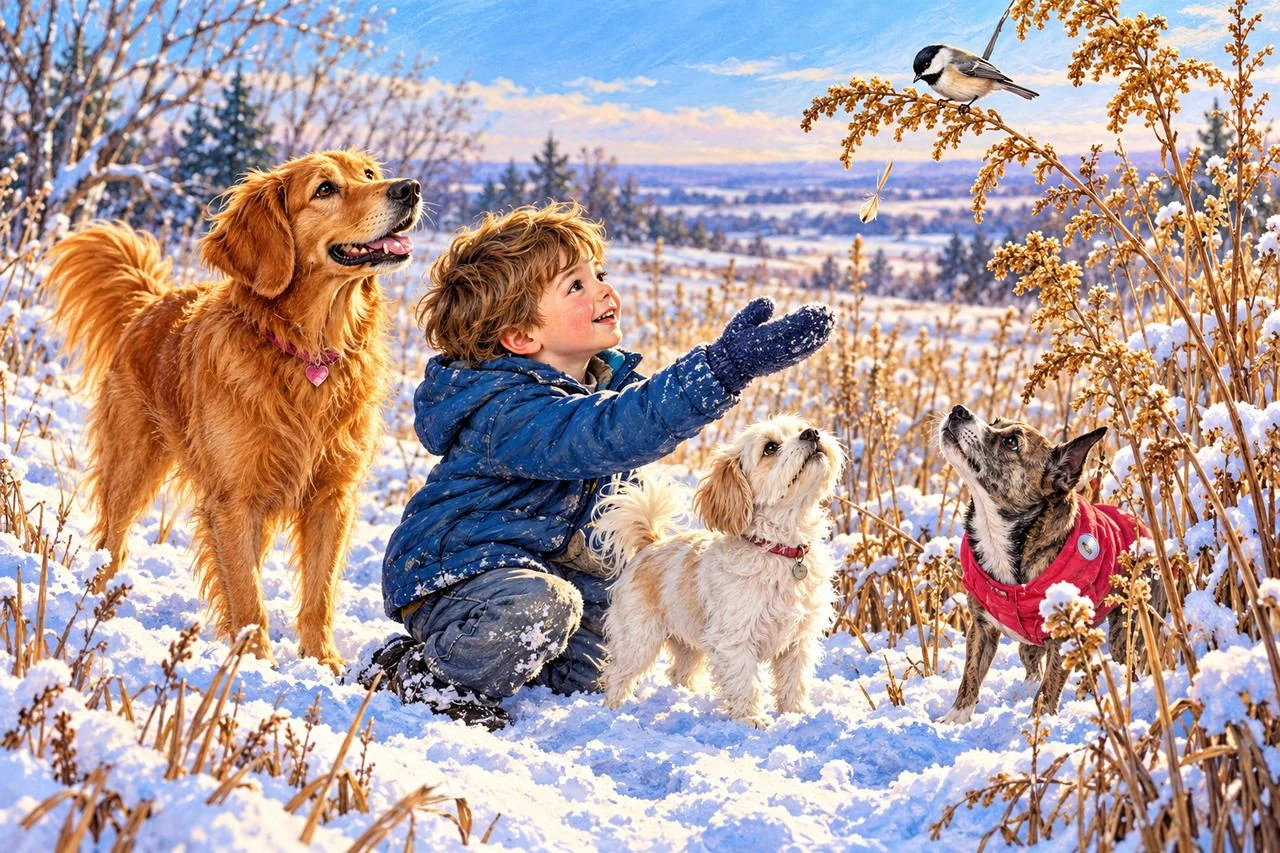
On a snowy morning Ruby and I met Ava at the prairie path. The goldenrod was brown. The asters had lost their purple. My human’s boots made a noise like somebody biting into toast.
My human opened the notebook the little gardener had lent us. The winter page was blank. “Nothing flowering today,” my human said, ready to shut it.
Ava tipped her nose toward a seed head bobbing above the snow. My human kept the book open. A little bird clung to the stem, took a seed and flicked the empty husk away. It landed on a mitten like a tiny paintbrush.
Ruby watched the stems still standing beyond it. Some kinds of bees spend winter inside old stems or underground. Young bumble bee queens can shelter in the soil. We didn’t need to dig or crack open a stem to wonder who was home.
My human drew the seed head. When the little gardener caught up with us, he drew the tracks we’d made getting there. His picture of me had five feet. I was willing to overlook that because he’d remembered both ears.
We passed the bare plots on the way to the tunnel. The boy took his July string from the notebook and laid it on the snow. He drew around it with one mitten. For a minute there was a summer squash in the middle of winter.
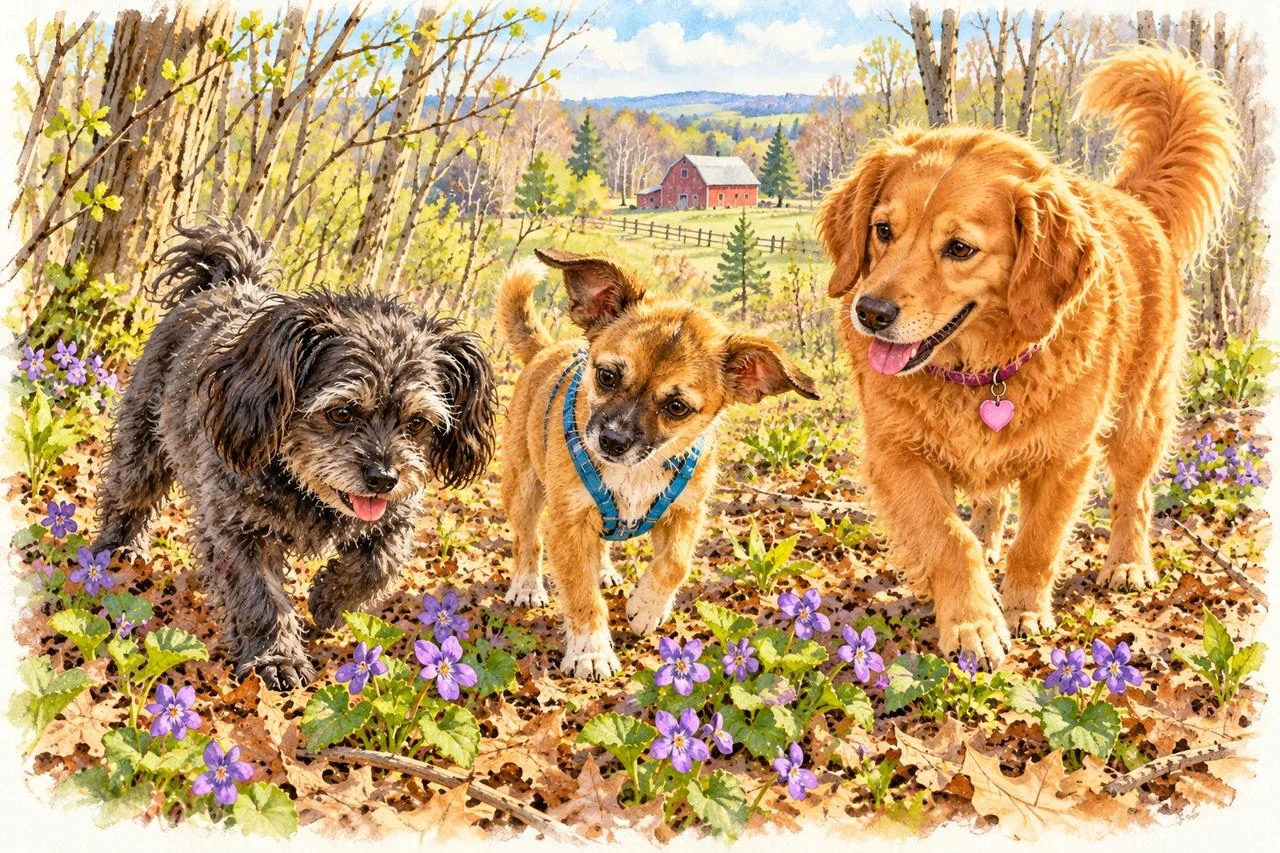
On the way home my tag jingled in the tunnel and the tunnel answered. Come spring, I’d meet Gizmo and Yoda near the red barn and take my human along. I knew whose noses to follow to the first violet.
This time, somebody else could keep an eye on the squirrel.
REMI’S LESSON
In winter you can look for what a flower left behind.
ON YOUR NEXT WALK
Remi’s field notebook
On your next walk, pick one flower you can see from the path. If a dog stops first, look where its nose is pointing. My human and I sometimes see different things from the very same spot.
Spring in the woods
When sunshine still reaches the ground between bare branches, look low for violets. Watch one blossom for a full minute. Does an insect visit? A visit and an empty minute are both worth writing down.
Summer in the gardens
Look behind a yellow zucchini blossom. A thin stem holds a pollen-making flower. A female flower has a miniature zucchini at the base of its petals. Watch from the path. Where does a bee pick up pollen? Where does it go next?
Summer on the prairie
A caterpillar chewing a milkweed leaf is doing a different job from an adult butterfly sipping nectar. Watch from the path and see if you can tell which part of the plant each one uses.
Fall at the prairie edge
Look for yellow sprays of goldenrod and the bright centers of asters. Where does a visitor land? Does it walk between tiny flowers or fly to another stem?
Winter on the same path
Find a dry seed head or listen for a bird feeding above the snow. Some insects shelter inside old stems or in the soil. Leave the stems standing and sketch what you can see from outside.
A QUESTION FOR YOUR NOTEBOOK
What did I actually see? What am I still wondering? Leave room for both.
BARN DRAWINGS / THE LOWER SIDE
Count the windows
From this side of the red barn, a row of small windows runs close to the ground. Look for the stone along the base, then follow the windows to the lower doorway.
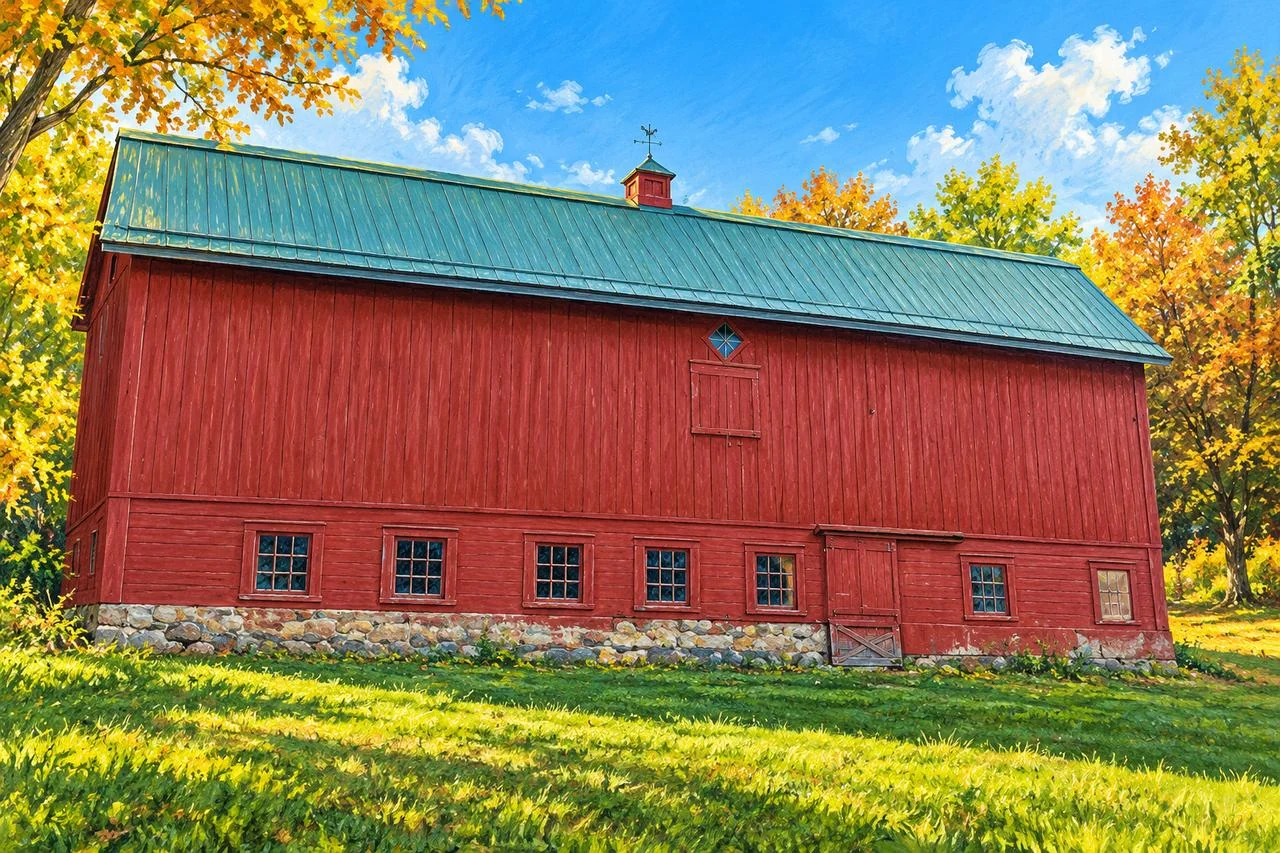
LOOK AGAIN
Put a finger beside one low window. Where would that window be in relation to the dogs’ heads when they stood in the room?
BARN DRAWINGS / THE HIGHER SIDE
Follow the hillside
Look at the uphill side of the same barn. Follow the ground to the broad red door. Which clues tell you the ground has risen?
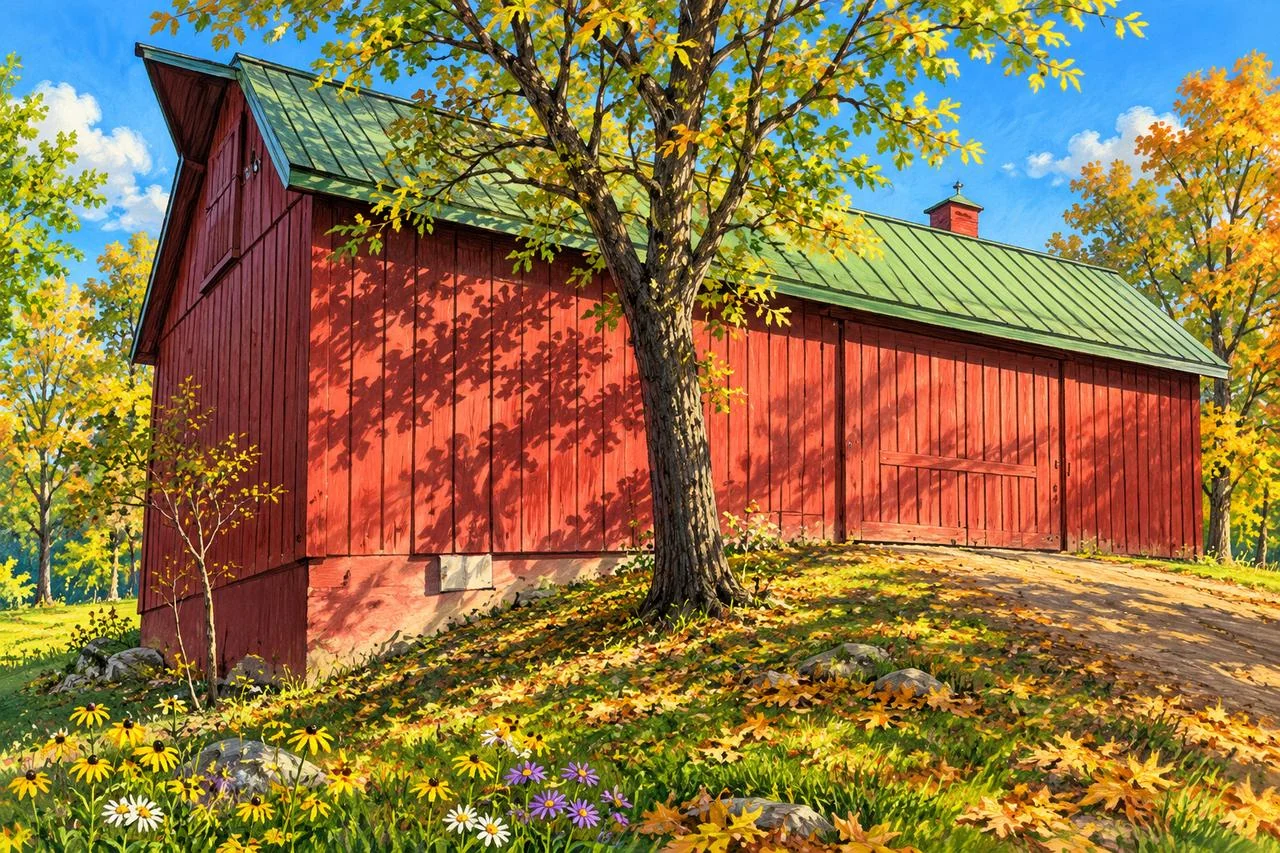
LOOK AGAIN
Trace the route in the air. In at the bottom. Out the same way. Up the slope. In the side door. Ava can visit both floors without finding a staircase.
PURGATORY PARK / FLOWER DRAWINGS 1 OF 4
Two flowers with frogs
Find the green frog on each flower. How can you tell the plants apart?
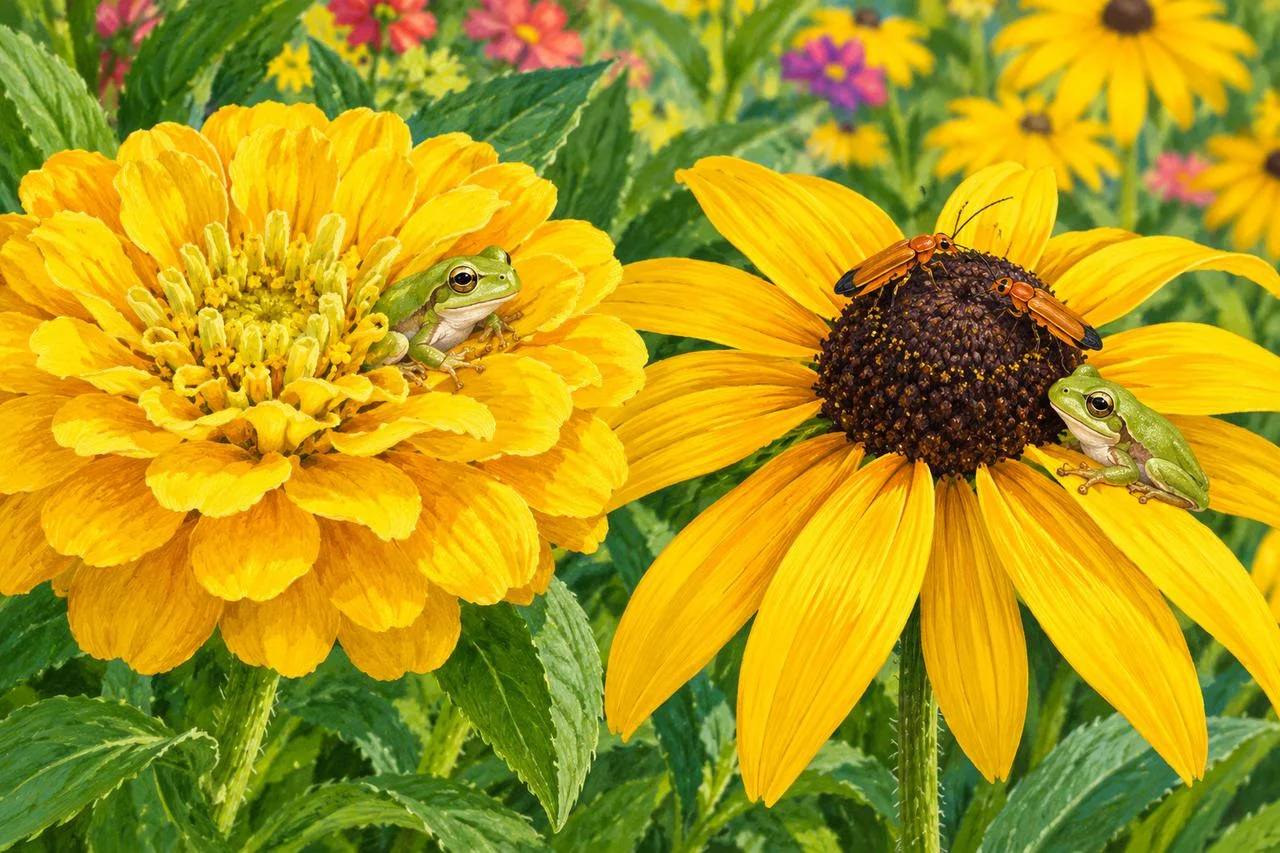
Garden zinnia
Layers of rounded yellow petals make a deep resting place for a little green frog.
Black-eyed Susan
Broad yellow rays ring a raised brown disk. Look for a frog where the rays meet the disk, and for orange soldier beetles with dark tips.
LOOK AGAIN
If you saw a frog on one flower and later on the other, what would you need to tell whether it was the same frog?
PURGATORY PARK / FLOWER DRAWINGS 2 OF 4
Plumes and paper globes
Both grow on tall green stems. Could you tell them apart without naming a color?
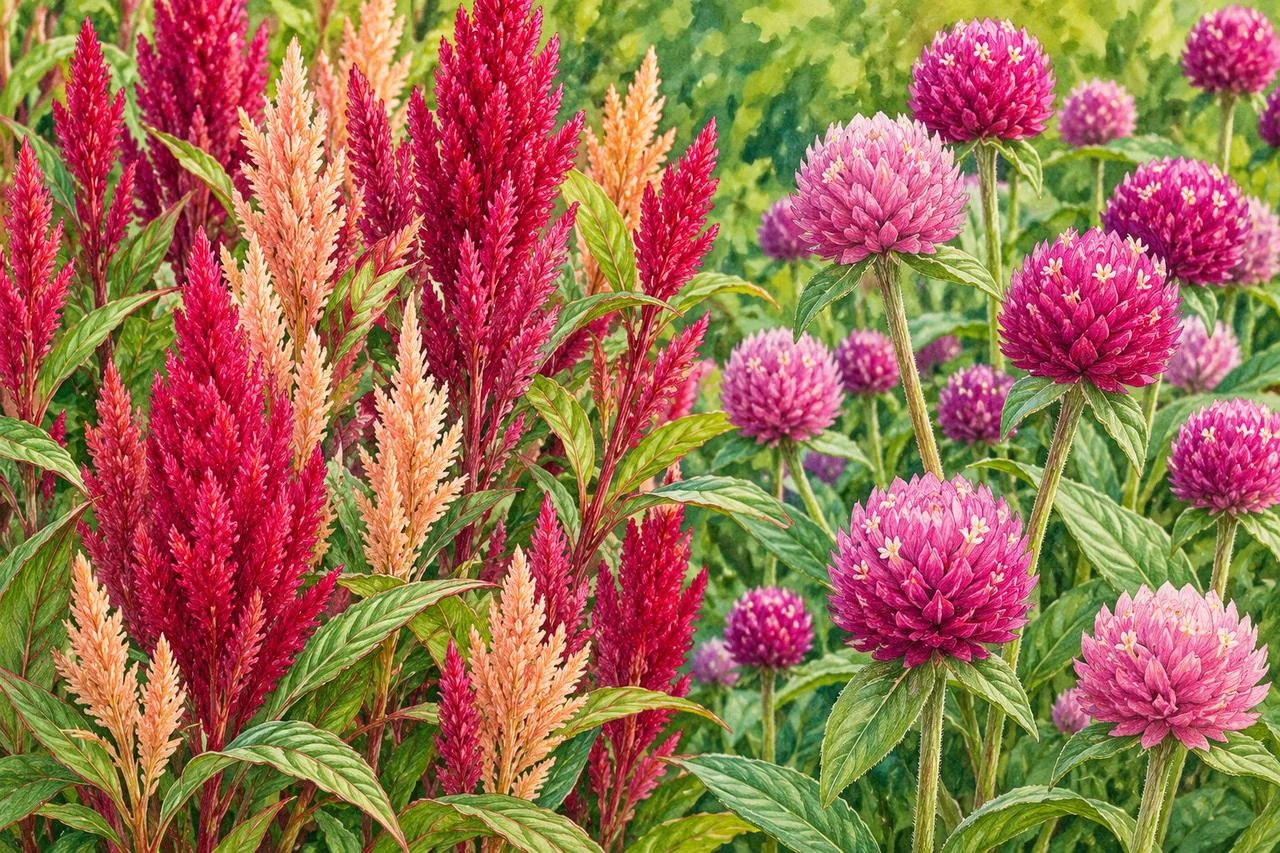
Plumed celosia
Follow the branches of a raspberry-red, peach or cream plume all the way to its pointed tip.
Globe amaranth
The pink-purple heads are round. Papery bracts surround the tiny flowers poking out between them.
LOOK AGAIN
Trace the outline of a plume in the air with one finger. Now trace a globe.
PURGATORY PARK / FLOWER DRAWINGS 3 OF 4
Behind the golden row
Start at the dark buttons in the foreground. Then lift your eyes above the gold.

Black-eyed Susans
Look for broad yellow rays around a dark disk that stands up in the middle.
Garden cosmos
Pink and white flowers balance on tall, fine stems. Their leaves divide into threadlike pieces.
Likely flossflower
Blue-lavender tufts edge the path. Their soft, fringed heads look different from the dark buttons on the Susans.
LOOK AGAIN
Can you find a white cosmos you missed on your first look?
PURGATORY PARK / FLOWER DRAWINGS 4 OF 4
Beside the garden path
Follow the tall flower spikes, then look lower for new colors and shapes.
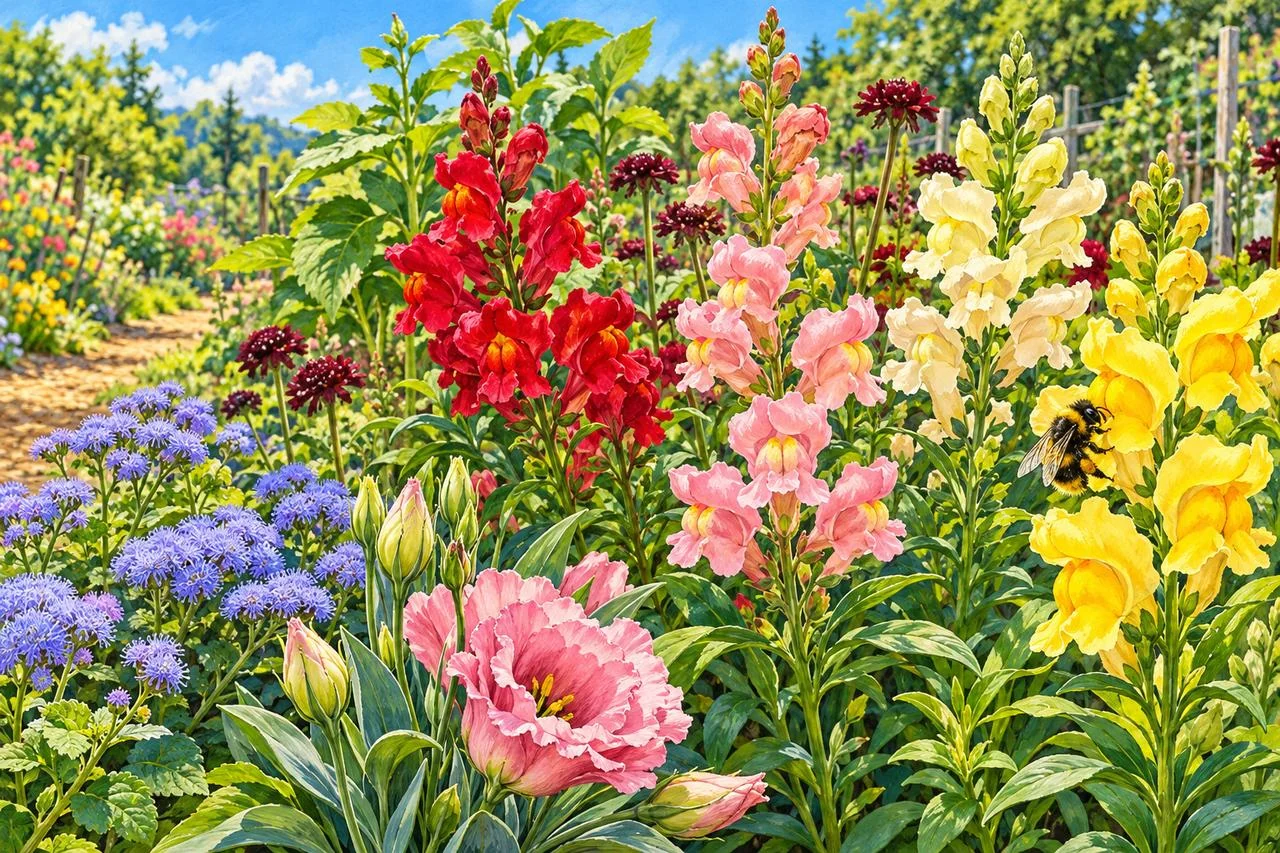
Garden snapdragons
Red, pink, cream and yellow flowers grow in spikes. The weight of a bumble bee can press a blossom’s lower lip open.
Likely flossflower
The lavender-blue clusters look fuzzy even in the shade.
Likely lisianthus
Look for a ruffled pink flower, long tapered buds and smooth blue-green leaves.
LOOK AGAIN
Behind the spikes, look for burgundy heads and broad leaves. They suggest pincushion flowers and possible sunflower foliage. A closer look would help settle the names.
COMMUNITY GARDENS / VEGETABLE DRAWINGS 1 OF 2
Tomatoes in every direction
Start with the red tomatoes. Now see how many green ones you can spot hiding among the leaves.
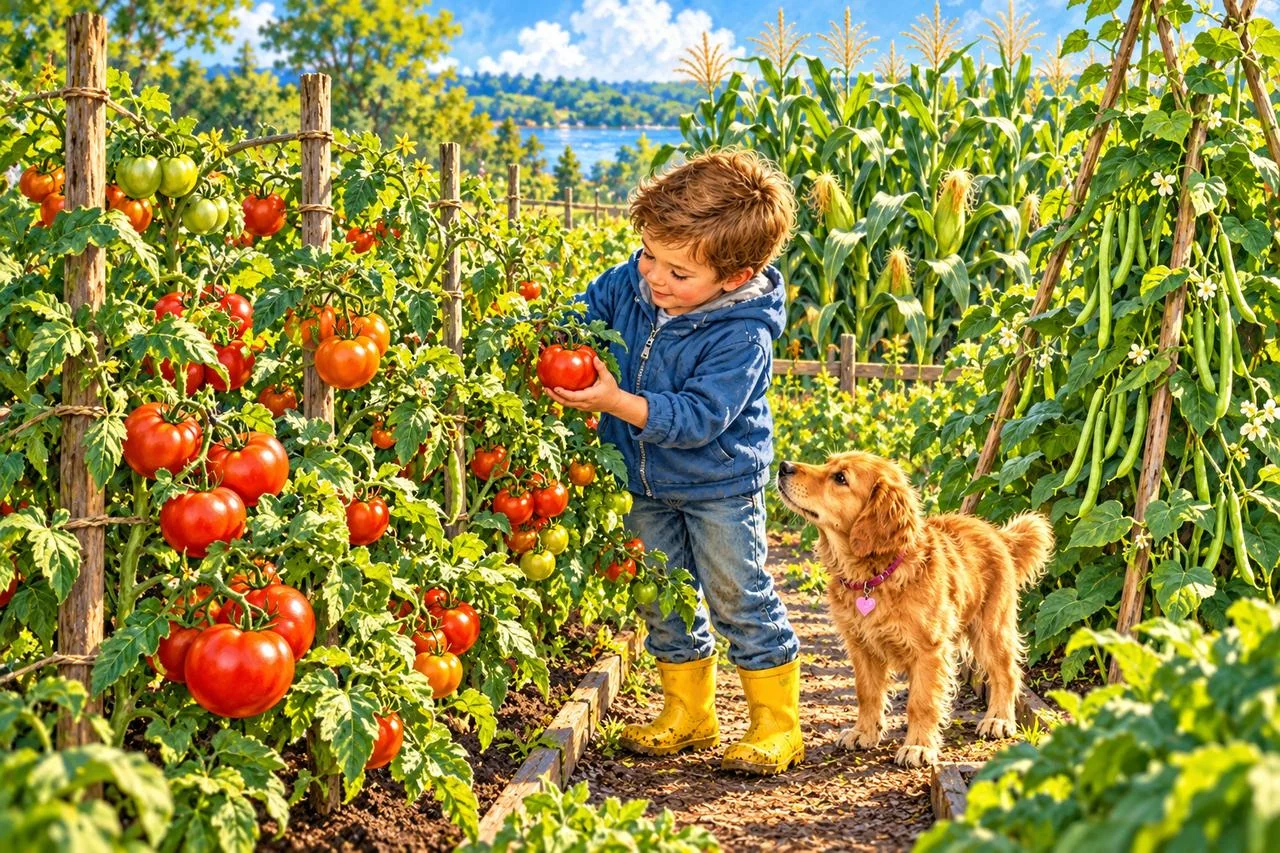
Tomatoes
Round fruit hangs in clusters against the stakes. Some tomatoes here are red enough to catch your eye from the next plot.
Pole beans
Follow a thin stem up its support. The long green pods hang down, even as the plant climbs.
Sweet corn
Look past the tomatoes for the tallest stalks. Tassels wave at the top. The ears grow lower down, wrapped in green husks.
LOOK AGAIN
Can you find a bean pod nearly the same color as the leaf behind it?
COMMUNITY GARDENS / VEGETABLE DRAWINGS 2 OF 2
Who left the papery clue?
One of these vegetables lost a scrap of skin in the wind. Look at the three harvest clues on the bench.
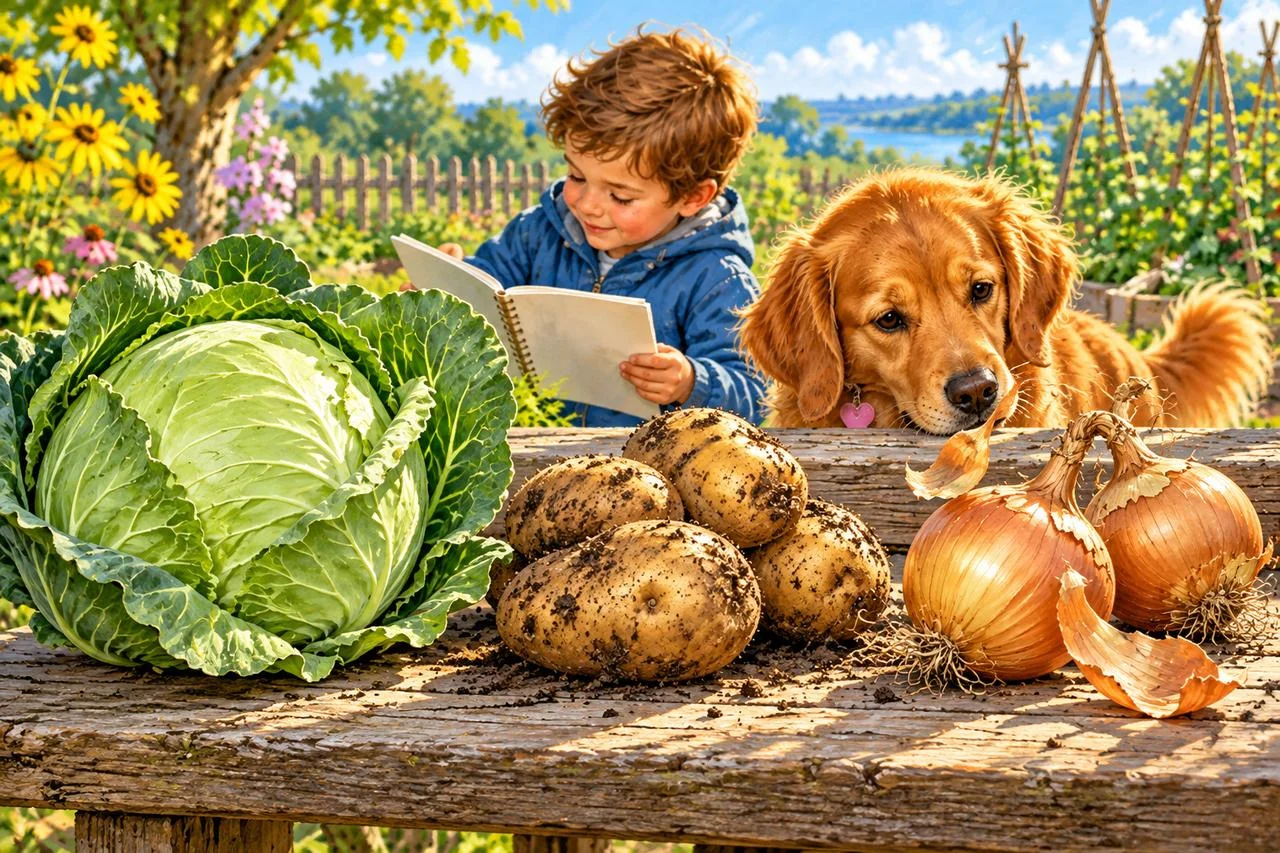
Cabbage
Broad outside leaves curl around a tight green head. Find one pale vein and trace it across a leaf.
Potatoes
These grew under the soil. Look for the shallow dimples gardeners call eyes. A new shoot can sprout from an eye.
Onions
Wispy roots hang from the bottom of each bulb. A dry outer layer can come loose in a thin, papery curl.
LOOK AGAIN
If the wind lifted one small piece from this bench, which vegetable would you check first? What would give it away?
THE DOGS / ALBA TO MAGGIE
Find your dog
These twenty-two dogs join the Remi Adventures stories for the first time. The chapter numbers include memories and mentions.
Asher
Shaggy eyebrows and a beard. Helps the gardeners look below a blossom and inside a zinnia.
Ava
Small brindle friend of Buster and Bugsy. Helps start the squash case and poses for the notebook.
Enzo Ferrari
Duke’s silky younger brother. Shows the little gardener how to measure a young zucchini.
Finnegan Gilbert
A puppy already bigger than Teddy. Counts wings and waits for a monarch to sip.
Kimber
Chocolate coat and a graying muzzle. Notices a bee returning to the same purple flowers.
Chapter 15
Maggie
Reddish-tan coat, pale face and white-tipped tail. Joins Odie for an echo in the tunnel.
Chapter 6
THE DOGS / MIRU TO YODA
More dogs to find
Look for the dogs by name and by the clue each one helped follow.
Miru
Tan coat and upright ears. Spots traveling pollen and the little frog tucked into a zinnia.
Remi (black Lab)
Bigger than the golden Remi. Glossy black coat, square head, ball chaser and swimmer. Follows the tiger swallowtail.
Ruby
Small white-and-cream dog with a plumed tail. Shows her human the swelling behind a squash blossom.
Winston (Winnie)
Sometimes joins the morning walk. Remembers the dogwood when he sees a zinnia.
Yoda
Little tan rescue dog with a white chest. Waits for the wind to turn a milkweed leaf.
Familiar faces
Remi, our golden narrator, is pictured in every chapter. Buster appears in Chapters 1, 3, 4, 6, 27 and 28; Bugsy in Chapters 1, 3, 6, 27 and 28. Gus and Teddy join Finnegan in Chapter 9. Duke joins his younger brother Enzo in Chapters 13 and 14. Find Sunny’s portrait beside his mention in Chapter 16.
FIELD NOTES / MINNETONKA
A walk through Purgatory Park
Remi and her friends are real dogs from Purgatory Park in Minnetonka. The flower drawings come from plants seen in the community gardens. The gardeners, their zucchini plant and the dogs’ conversations belong to the story.
The gardens by the tunnel
The red barn is on the way to the gardens. The dogs return to the main trail and go through the tunnel to reach them. Tomatoes turn up in plot after plot. Sweet corn, beans, cabbage, potatoes and onions grow here too. The zinnias and black-eyed Susans in the drawings grew in one of the flower plots.
Purgatory Park
Purgatory Community Preserve has woods, wetlands, prairie and the creek. Friends of Minnetonka Parks names gray dogwood and goldenrod in its site account. It reports monarchs, brown-belted bumble bees and the vervain mining bee (Calliopsis nebraskensis). The last of these gathers pollen from vervain and nests in the sandy prairie. City park profile · Friends’ park account, including 2024–25 field notes
Following the seasons
The violet, milkweed, evening primrose and asters are Minnesota examples in imagined scenes. Their exact spots and bloom dates at Purgatory Park would take observations on the trail to confirm. In winter, the story looks for seeds and shelter after the blooms have finished. Minnesota bloom guide · Evening primrose
An invitation from Remi
Walk with an adult, stay on the path, and give garden plots and sandy nest entrances room. Take a picture or make a drawing. Write down the place and date. Next time you come, you’ll have something wonderful to compare.
FIELD NOTES / FURTHER READING
Notes for grown-ups
From zucchini blossom to supper
A tiny zucchini is visible behind a female blossom even before a bee arrives. When a bee transfers enough pollen, the fruit can keep growing. Gardeners pick zucchini young, while the skin is tender. That lets the boy in the story follow a marked flower all the way to supper in summer. University of Minnesota Extension, reviewed 2024 · South Dakota State University Extension, August 2024
Who visits a flower
Adult hoverflies can resemble bees. In some species their young eat aphids. A zinnia head bears many individual florets. The tiny stars in its center give a visitor several places to feed on one landing. Minnesota Extension on hoverflies · NC State on zinnias
After dark and on migration
In a 2023 English bramble study, moths accounted for most nighttime visits, and flowers exposed at night received pollen. Eastern monarchs use milkweed as caterpillars and nectar from flowering plants as adults. Many travel to Mexico for winter. March 2023 moth study · U.S. Fish and Wildlife Service on monarchs
What survives the winter
Some bees overwinter in plant stems. Young bumble bee queens can overwinter in the ground and look for early blooms after emerging. Goldenrod seed heads also feed small birds in winter. University of Minnesota Bee Lab · Spring queens, May 2026 · University of Minnesota Season Watch
FIELD NOTES / GARDEN DRAWINGS AND BUTTERFLIES
Garden and butterfly notes
What the drawings show
Five photographs from a community plot at Purgatory Park guided the flower drawings. Two close-ups showed frogs, and one also showed beetles. The source photographs leave some varieties uncertain. A park visitor’s description supplied the clue for the yellow butterfly.
The yellow butterfly
Large yellow wings crossed by black stripes suggest a tiger swallowtail. The eastern tiger swallowtail (Papilio glaucus) is a local possibility. A university specimen from Edina, Hennepin County, dates to August 2, 2001. The Canadian tiger swallowtail (Papilio canadensis) looks similar. A clear underside photo would help distinguish them. The story uses the shared name. Hennepin County specimen · Eastern tiger swallowtail · Canadian tiger swallowtail
Plant clues
A Minnesota cut-flower trial describes zinnias, celosia, snapdragons and ageratum. Regional and botanical garden guides help explain the features in the garden drawings. Minnesota cut-flower trial · Rudbeckia, September 2021 · Cosmos · Globe amaranth · Lisianthus · Pincushion flower
Visitors on the petals
Adult soldier beetles visit flowers for food and can move pollen. The little green frogs resemble treefrogs. Minnesota’s gray treefrog and Cope’s gray treefrog can look alike, and their calls are a much better clue than the green color. University of Minnesota Extension on soldier beetles · Minnesota DNR on treefrog identification
ONE LAST CASE
Your turn, detective
Pick one living thing you can see from a path. You can do this at a garden, in a park or from your own doorstep. A dandelion in a crack will do.
First look
Choose one detail small enough to draw. Add something beside it for scale, as Enzo did with the spoon. Write the date and the place.
A minute later
Watch the same spot for a minute. Draw anything that moved. If nothing moved, you still have something to compare next time.
On your next visit
Find your spot again. Show a friend what changed and what stayed the same. If you have a guess, tell your friend which part you saw and which part you’re still wondering about.
And if your dog sits down in the middle of the walk, have a look where her nose is pointing. She might have found the next chapter.